Mary, a Feminist?

Mary, a feminist? 1: Reading of this post

So here is a bit of a confession for a Catholic: I have struggled and wrestled for a long time with what I feel about Mary. There were those porcelein statues around, and this image of perfection which immediately condemned me as a failure as a woman: virgin or mother, you cannot be both, so choose one and know that you will always only be half a woman. It is the message I was receiving as I grew up as a female. And of course, she is the mother of Jesus, He loved her, He listened to her – the miracle at Cana? I am sure you know what I mean. So, I felt guilty and ignored the issue. Evangelicals are often critical of Catholics, saying that they worship Mary, and there is only one God, and while I might concede that to them, that might indeed be what it looks like, but from a Catholic perspective, if life in God is eternal, then praying to Mary (and the saints) and asking her and them to pray for me is not really that much different from asking my friends and church community to pray for me. Why would you not? No, It is not the “You Catholics worship Mary, and that is blasphemy” accusation that bothers me about Mary, and yes, that has been said to me more than once: it is more the passive, bland , vanilla image of her and how it is held up as the ideal for women who love God. Is this really who His mother is?

I read a couple of short stories which featured Mary, or an image of her, that resonated with me and made me think more deeply about the images we are presented with. One of them in The Seven Deadly Sins, on Anger, says:

…On the opposite wall above the sink there was a reproduction of a medieval Virgin and Child. The Virgin in her jewelled head-dress knelt in dazed adoration before the cradle, her hands meekly folded in prayer.

‘That’s what he wants,’ she thought, ‘That’s what they all think they have a right to.’

She Went of Her Own Accord, Kate Saunders, The Seven Deadly Sins

And another, where she appears to a black man on the run and asks him to melt her:

I could never cry after that day for His loss. Since I was made marble, wax, sculpted wood, gold, ivory, I’ve had no tears. I had to carry on living this way, with a lie of stupid smiles painted on My face. Tristan, I was not what they have painted. I was different, certainly less beautiful. And I have come to tell you something.

The Fall, Armonia Somers in Other Fires: Stories from the Women of Latin America , edited by Alberto Manguel

The first quote illustrates my frustration with the images we are offered as women, and the second, scandalous hope. If you want to know more about that , I recommend Armonia Somers’ story. It is not for the faint hearted.

The Great Mother, Jen Delyth
Mary, a feminist 2: Reading of this post

I was so much ill at ease with images of Mary that it got in the way when I was making the Exercises. During the first week, Ignatius suggests a triple colloquy at the end of the prayer sessions:

The first colloquy will be with our Blessed Lady, that she may obtain grace for me from her Son and Lord for three favors:

A deep knowledge of my sins and a feeling of abhorrence for them;

An understanding of the disorder of my actions, that filled with horror of them, I may amend my life and put it in order;

A knowledge of the world, that filled with horror, I may put away from me all that is worldly and vain. Then I will say a Hail Mary.

The Spiritual Exercises of St. Ignatius, trans. Louis J. Puhl S.J.

I could not get on with this practice at all. When I tried, my conversation with her was stilted and awkard, like I was trying too hard to be polite and to like her – I realised that she was a bit of a stranger to me. And when Jesus appeared with us in the second part of the colloquy, I just looked at Him agog – it was like even He was on His best behaviour, and not behaving like Himself at all! My director at the time wisely suggested leaving the triple colloquy alone since it was getting in the way, and to do the colloquy as before.

A photo of the picture of a young pregnant woman. It is one of the pictures around the house at St. Beunos. I prayed with it over the course of a day, with Psalm 63, after I had medidated on The Annuciation during The Spiritual Exercises.
Mary, a feminist 3: reading of this post

Ultimately though, it was at the beginning of the second week of the Spiritual Exercises that I felt inspired to really examine my perceptions and images. My director, again, wisely encouraged me to spend extra time on the space between the first contemplation and the Nativity, and more time with Mary during the hidden life meditations.

In the first prelude of the first contemplation of the second week, Ignatius encourages us to imagine the Holy Trinity looking upon the Earth and humanity, and coming up with a plan:

Here it will be how the Three Divine Persons look down upon the whole expanse or circuit of all the earth, filled with human beings. Since They see that all are going down to hell, They decree in Their eternity that the Second Person should become man to save the human race. So when the fullness of time had come, They send the Angel Gabriel to our Lady.

The Spiritual Exercises of St. Ignatius, trans. Louis J. Puhl S.J.

In my imagination, the Holy Trinity were discussing the hows and when of putting the salvation plan into actions and had agreed that it would be inititated when:

She prays psalm 63.

In the next contemplation, The Annunciation, I was an invisible observer, watching and listening to Mary at prayer, and when she prayed psalm 63, it completely blew me away! In The New Jerusalem Bible, which is the one I normally use for prayer, the first part translates as:

God, you are my God, I pine for you;

my heart thirst for you,

my body longs for you,

Psalm 63…The New Jerusalem Bible

The moment I heard her say the words in bold, there was what seemed to me at the time, a scandalous and shocking revelation that I recognised as “screaming womb”. Such was the ferocity of her desire and love of God, that it went far beyond the sexual imagery of desire of The Song of Songs, which of itself, can make uncomfortable reading. It is a young woman saying:

I want to have your baby.

And the answer to her biological question of how can it be, the mystery of it, is given in the psalm:

…and in the shadow of your wings I sing for joy.

My soul clings to you;

Psalm 63: 7b-8a

So I began to see her in a new light, as an audacious woman who loved and trusted God to the exclusion of everything else: social propriety and the thoughts and feelings of her betrothed included. As Grandmother Widow (myself as an Old Woman) said to her in a later imaginative contemplation:

You never even gave Joe a second thought, did you?

I developed a friendship with her from there: as the mother of my own inner child, little Sunflower, I brought her over for “playdates” with Jesus, and while they played in the garden fountain at the age of three, laughing and splashing, Mary and I talked. When I was overcome with tiredness, she looked after the children and let me sleep. She became for me, a real person and not an alabaster statue.

I do not know who created this image. If anyone is able to enlighten me, please do, because I would like to attribute it properly.
Mary, a feminist 4: reading of this post

I went to the Ignatian Spirituality Course Triennial lecture given by Jerrfey John, an Anglican Theologan. It was about Mary in scripture, and we were presented with different images of her. My favourite, Che Maria, was put with The Magnificat and presented her as Mary the Revolutionary. John talked about Henry Martin, who went out to Calcutta as a chaplain:

When he got there, he was astonished to find that the local Governer had ordered the Magnificat to be ripped out of the Prayer Book, and forbade it to be used in church services, because he was convinced that if the natives heard it they would be inspired to rebel.

Jeffrey John, Mary in Scripture, ISC Triennial lecture 2019.

John also pointed out:

…in 1978 in Beunos Aires, the mothers of all the ‘disappeared’ people who had been kidnapped and killed by the military junta in Argentina, gathered tohether in the Plaza de Mayo to fight back. One of the ways they did it was by plastering the text of the Magnificat everywhere, and endlessly singing it in front of Government headquarters until in the end the Government, very stupidly, tried to ban it.

Jeffrey John, Mary in Scripture, ISC Triennial lecture 2019.

And he asserted that the song the punk band Pussy Riot sang in the Cathedral of the Holy Saviour in Moscow in 2012, and were jailed for, was a prayer to Mary to drive Putin away, and was very much in the spirit of the Magnificat.

Dallas Jenkins (The Chosen), talks about the care he took in the portrayal of Mary in Episode 5 of Season 1.

Mary, a feminist 5: reading of this post.

Dallas asks towards the end of this discussion:

How did we do?

I think they did a great job. Here is a woman I can relate to.

On our spiritual journey, I have learned that it is important to consider our image of God. Sometimes we can cling to unhelpful images of God that prevent us from moving into deeper intimacy with Him. I have come to understand, since I did The Spiritual Exercises, that the same is true of His mum. Getting to know her better has allowed me to indeed see her as an example and role model, but not in the way that others tell me to see her. To see her audacity, a woman who submits to God’s authority regardless of what the patriarchy tells her that looks like. Does that make her a feminist? To me it does. She believed that her free will allowed her to make a choice without first running it past a societally approved man; she made that choice, trusted God and lived with the consequences of it. In my eyes, she is an awesome role model for this reason and I am pleased to call her my friend.

The Magnificat

‘My soul magnifies the Lord,
47     and my spirit rejoices in God my Saviour,
48 for he has looked with favour on the lowliness of his servant.
    Surely, from now on all generations will call me blessed;
49 for the Mighty One has done great things for me,
    and holy is his name.
50 His mercy is for those who fear him
    from generation to generation.
51 He has shown strength with his arm;
    he has scattered the proud in the thoughts of their hearts.
52 He has brought down the powerful from their thrones,
    and lifted up the lowly;
53 he has filled the hungry with good things,
    and sent the rich away empty.
54 He has helped his servant Israel,
    in remembrance of his mercy,
55 according to the promise he made to our ancestors,
    to Abraham and to his descendants for ever.’

Mary’s song of Praise. Luke 46b-55

Ask a Spiritual Director: Margaret Mary McFadyen

Here, I am adding a new feature to my blog: interviews with spiritual directors. I am starting with myself, since I think I should not ask people to do something I am not prepared to do myself, and using questions I have been asked, or I have asked, or people have suggested I ask in response to my request for questions. I hope you find it enlightening, and if you do have other questions you would like to ask spiritual directors, please add them to the comments for this post.

Margaret Mary McFadyen: Ignatian Spiritual Director

When people ask you what a spiritual director does, how do you respond? 

I always find this one a bit tricky and never really feel that I get it “right”, especially when I’m talking to people who don’t have a religious faith. I usually say that it is a bit like counselling, except that we talk about the person’s prayer life, their personal relationship with God and the way they live their faith. With non-believers, the usual response is for the eyes to glaze over; for believers who believe themselves do be doing fine in that department there is a polite nod or explanantion to that effect. Sometimes though, with other believers, it makes a connection within someone for more and they start to ask more questions, becoming more thoughtful. Often, these are the ones which will go on to seek ongoing spiritual direction in their lives – not necessarily from me, I hasten to add. I am not necessarily the most appropriate person for them.

What’s the difference between spiritual direction and counselling? 

If I were to sum it up, and based on my own experience of receiving both – I have talked to counsellors during periods of crisis and stress in my life – I would say it is about the purpose and the effect. Even though spiritual direction might overlap a little with counselling, it is not the same thing. I would say counselling is when you are having trouble functioning “normally” in everyday life, when there are issues getting in the way of day to day living. Counselling can help us back onto our feet when we are in crisis. With spiritual direction, on the other hand, we may be ticking along quite nicely, working, living, socialising but we have a sense of there must be more to life than this. Spiritual direction helps us to focus more on those subtle nuances, to improve our day to day conscious contact with God, to deepen our listening and gently and gradually, we begin to live more intimately with God amd more in tune with ourselves, in what He designed us for. It is extremely liberating to live in this way, in my experience.

What made you become a spiritual director?

I would say it was a “first time choice” as St. Ignatius describes in The Spiritual Exercises. I was on retreat at St. Beunos one summer and during mass, at the quiet bit around communion, I was pondering my own spiritual director in life, and the director who was working with me on the retreat – both wise and gentle people who were making a difference to me. I felt a wave of gratitude for them, and for every other director who had contributed their wisdom to my faith journey, and I expressed this sentiment in a prayer. I then “heard” or “felt” the words whispered:

You could be a spiritual director.

I was immediately calm and curious, because I recognised that I had a desire to do that, even though it had never occurred to me before, and I knew who to ask about doing it.

How did you go about training to be a spiritual director? 

My own director was involved with the Ignatian Spirituality Course which was running at The Centre for Spiritual Direction in Lombard Street in London. The course has moved to Mount Street recently. After sitting with the idea for a bit, on the second meeting with him after my retreat, I told him about my experience on retreat. I had a sense that his response might give me an indication of whether I would be a suitable candidate for the course or not. He beamed at me when told him about it, and responded very positively, which to me was very affirming. I had a few things to work out, like going part time in my day job and how I was going to finance it, but the rest is history as they say. I started the course at the next intake.

What is it that draws you to Ignatian Spirituality in particular? 

I remember an adult of my parent’s generation in the church saying to me when I was a teenager:

It’s dangerous to think.

and I knew I didn’t agree with them; I vehemently disagreed with them. Silently, of course, because it would have been deemed as insolent if I had spoken out at that time. I was curious as a student, and well into chemistry at this point. There were more questions than answers, and the interest and questions were self perpetuating. St. Ignatius describes our reason, our ability to rationalise as the second power of the soul: he encourages us to engage our brains with our lived faith, not turn them off. I might not have known that explicitly, but I felt comfortable around Jesuits and enjoyed the sermons whenever I heard them because they stimulated my brain. Imaginative Contemplation is also something I really get into and I started to experience this form of prayer on retreats when I was a student. I’ve been told that I have a very vivid imagination, and this form of prayer connects me deeply to living with God. Ignatian spirituality suits my personality at the end of the day; I feel at home there.

What do think are the benefits to receiving spiritual direction?

Receiving spiritual direction raises our conscious contact with God. We become better at listening and noticing where God is calling to us, and our desire for God increases. It is a safe place to say things that we might not be confident about saying out loud, even to those we are close to, because it could invite critcism, or people think we are weird, or worse. If you say things like “I heard God say…” in the real world out there, it can be received with derision and hostility and that is not a safe environment in which to explore what is going on. Sure, the spiritual director might ask “How do you know it was God?” and that is an important part of the discernment process. They are not unbelieving in the idea that God speaks to us through our imagination, thoughts, dreams and experiences. Personally, at the beginning of my Ignatian journey, I found it difficult to talk about what was happening within me. I worked with sceptical scientists after all and even the fact that I believed in God was often regarded as a curious anomaly, even though it is not really that rare to believe in science and in God. Being able to open up about my personal relationship with God in spiritual direction, and to explore it openly and safely in this way, has literally changed my life and to find out who I really am and who I am created to be at a profound level. I would definitely recommend it.

When starting on a session or series of sessions with a client, do you like them to begin by talking about how they feel and what they are hoping for from the experience, or do you prefer to let this emerge gradually, perhaps with the help of imaginative prayer? 

I always start my sessions the way my directee would like them to start. With most of them, they like to start with a prayer, so I use an informal prayer around the preparatory prayer and the presupposition of the Spiritual Exercises and the annotations, bascially asking for open and honest discussion, for each to presuppose the good intentions of the other, and for where there is a lack of clarity, to ask. I think this format is helpful in reminding us both of the purpose, and that if the communication is not quite flowing, that no judgement or ill is meant by it, and that asking for clarification is the way to go to open things up. When people are sharing deeply and of painful things, it is important to know that I am not sitting in judgement of them. I am aware that I can sound like my “teacher voice” and I furrow my brow when I am thinking, which can also leave people wondering if they have said something wrong! Not my intention at all, so asking for clarity is always open. Otherwise, I am there in service of my directee, so I allow things to emerge, and I will lead in an imaginative contemplation as appropriate, usually by prior arrangement.

Do you start your sessions with a prayer?

I do , as I said in the previous question, if that is the preference of my directee. Interestingly enough though, I do not like to start with a prayer when I am receiving spiritual direction. When the director does that, I feel that I have to be a “good girl” in the session, and it limits my expression of negative feelings and attitudes, thus not allowing me to explore deeply what is going on. Whenever that happens, my sense of the process is superficial. Fortunately, my director in life does not start our sessions that way and it has allowed me to fully explore the good, the bad and the ugly. God, after all, sees it all.

Why do you have supervision as a spiritual director?

At the very least, we pray not to get in the way.

Gerard W. Hughes, Loyola retreat, 2009

I was fortunate to go on this retreat that Gerry Hughes led in Loyola, and this is what he said about spiritual directors in his introductory talk on the first evening of the retreat. For me, it sums up the role of supervision. I have my own feelings, issues and biases – I am a human being, and some of these may be subconscious. The spiritual direction conversation is between the directee and God, and I am the channel that seeks to facilitate that conversation. Supervision helps me to be aware of what is going on inside me that might be helpful or detrimental when I am directing, so that I can adjust and maintain that position of equilibrium in order that God can work with the directee, without me getting in the way.

How do you feel about online spiritual direction?

Online spiritual direction has been one of the surprises of the pandemic for me. I was sceptical at first, thinking it would be better that nothing but I was dubious about how well it would work. I still believe face to face to be better, but in both receiving and giving spiritual direction online, as well as receiving supervision, it has changed my opinion. I think it has value in itself and may be the way forward for people who would like to receive spiritual direction, but live too far away from any directors to make it practically possible to travel. I travel for 2 1/2 hours to see my director and it takes up most of the day. Not everyone is able to do this, but online makes it possible, even for the busy working person or parent who might not catch a break until the evening. I’m excited about it as a possibility for widening the reach of spiritual direction.

Do you charge for spiritual direction? 

I do ask for a donation in line with earnings. I firmly believe that the labourer deserves their wage, and that if the Levites were not sustained by the people’s tithes, they would not be able to look after the temple, but would have to be working in the market places and farms in order to live. I do pay my own director. It is very difficult, if not impossible, to make a living as a spiritual director. Most do it as part of a paid ministry, or have some other form of income – a day job. I teach in a school. I have directed people for free when I knew they were not in a position to pay. It is the work that is important after all. At the most, I hope to at least break even, after I have paid for supervision and ongoing CPD courses to support my work. Over the course of a year, I will generally have received more than I have spent.

If someone wanted to receive spiritual direction from you, how could they go about contacting you?

They could contact me here, through my “Contact me” page, or by leaving a comment, or through my email address published on the Spirituality Page on the RCDEA website.

Finally, thank you for taking the time for this interview, and for your openness and honesty. God bless.

Thank you.

Margaret Mary McFadyen.

Came to believe. Step 2 and The Spiritual Exercises

Came to believe. Step 2 and The Spiritual Exercises 1: Reading of this post.

Came to believe that a power greater than ourselves could restore us to sanity.

https://www.alcoholics-anonymous.org.uk/About-AA/The-12-Steps-of-AA
At the centre of the labyrinthe at St. Beunos
Came to believe. Step 2 and The Spiritual Exercises 2: Reading of this post.

I can honestly say that the last two weeks have been hectic in a way that I have not at all enjoyed. I would go as far as describing it as the First of the Twelve Steps:

We admitted we were powerless over alcohol – that our lives had become unmanageable.

https://www.alcoholics-anonymous.org.uk/About-AA/The-12-Steps-of-AA

I am not specifically speaking about alcohol here, but the powerlessness I have experienced over my life is real and with it, the sense that it is completely unmanageable. Very quickly, I started to realise that I am living step two, that amidst this turmoil of spirits I have been experiencing, I am reaching out to God and believing that He can indeed restore me to sanity, and that in fact, it is exactly what He has been doing since I made the Exercises, and for a time even before that. So, I am making a discernment about my life.

In Breathing Underwater, in the chapter on Step 2, Richard Rohr writes:

The immediate embrace is from God’s side, the ineffectiveness is whatever time it takes for us to “come to believe”, which is the slow and gradual healing and reconnecting of head, heart and body so that they can operate as one.

Breathing Underwater, Spirituality and the Twelve Steps. Richard Rohr

He makes the point that there is a process here, a lag time. We do not suddenly believe that God can restore us to sanity, as it says in step two, without a precursor to that belief. The first step may come as a revelation, where there is a desire and a possibility for change, and no doubt about it; what Ignatius describes in The Spiritual Exercises as First Time Choice:

When God our Lord so moves and attracts the will that a devout soul without hesitation, or the possibility of hesitation, follows what has been manifested to it. St. Paul and St. Matthew acted thus in following Christ our Lord.

The Spiritual Exercises of St. Ignatius trans. Louis J Puhl S.J.
Sundial, Penhurst
Came to believe. Step 2 and The Spiritual Exercises 3: Reading of this post.

The second step is not quite the same thing as it is lived. I have heard a lot of people share and talk about reaching their “rock bottom” and tell that they felt that this recognition of their own powerlessness and the unmanageability of their lives had come from outwith themselves. In step two though, there is more of a struggle: with some, it is in accepting a Higher Power, where there was no belief in God previously, and with others, where there is already a faith in God, it is in deeply believing that God can restore us to sanity and living according to that belief. I include myself in this latter category.

I read somewhere, a while back, words to the effect of:

If Christians believe that they are truly saved by the sacrifice of Jesus, why do more of them not live more joyfully, as if it were true?

I do not remember where I read this, or the exact quote: it may have been Richard Rohr or James Martin who said it in one of their books, it may have been Anthony Flew in “There is a God”. Nevertheless, the sense of it has remained with me and it connects me now to this second step. We can believe in God, but to trust Him and live completely in that trust is a different thing, not least because we have to discern the movements within us, our desires and our fears. God’s voice is not the only one speaking to us, either through the people we meet, the events in our lives or within our own minds and hearts. Discernment takes listening, and listening takes time and consideration, and noticing the effect of these different voices on our soul. Ignatius describes it as turmoil of spirits and calls it second time choice:

When much light and understanding are derived through experience of desolations and consolations and discernment of diverse spirits.

The Spiritual Exercises of St. Ignatius trans. Louis J Puhl S.J.

I would say that I am generally a fairly decisive person. I joined Al Anon for the first time when I was seventeen, and one of the tools of the program that I have worked with a lot over the course of my life is the Just For Today card. One of my favourites from this card is:

Just for today I will have a program. I may not follow it exactly, but I will have it. I will save myself from two pests: hurry and indecision.

Al Anon : Just For Today

It is a curious back and forth I am describing here. I have some control over the decisions I make, and yet I am powerless, and I come to believe that God can restore me. The process that links the powerlessness of the first step and the believing that God can restore me is in the discernment, the sitting with and noticing the push and pull in the turmoil of spirits. When I have made a decision, and I am resolved in that decision, I do act “decisively” to carry it out. Sometimes, it is only the action that people see from me, and not the process that has gone into that decision. This Just for Today focus highlights two pests in the process of making a change and in trusting God in making a change: hurry and indecision, both of which we might attribute the label “spiritual desolation”:

I call desolation… darkness of soul, turmoil of spirit, inclination to what is low and earthly, restlessness rising from many disturbances and temptations which lead to want of faith, want of hope, want of love. The soul is wholly slothful, tepid, sad, and separated, as it were, from its Creator and Lord. For just as consolation is the opposite of desolation, so the thoughts that spring from consolation are the opposite of those that spring from desolation.

The Spiritual Exercises of St. Ignatius trans. Louis J Puhl S.J.

The time it takes to “come to believe” allows for this discernment process, a growing into faith and trust in God. We do not need to beat ourselves up that we do not enter at this point of somehow magically trusting God, for to do so may lead to self loathing, or even believing that we do really trust God may of itself be pride, a lack of humilty, that our trust is all our own achievement:

Am I not so good? Of course I trust God completely!

Memento Mori, Vanitas. “Pride” From my series on The Seven Deadly Sins.
Came to believe. Step 2 and The Spiritual Exercises 4: Reading of this post.

Spiritual consolation, as described by Ignatius, is the movement towards deeper trust in God:

I call it consolation when an interior movement is aroused in the soul, by which it is inflamed with love of its Creator and Lord, and as a consequence, can love no creature on the face of the earth for its own sake, but only in the Creator of them all. It is likewise consolation when one sheds tears that move to the love of God, whether it be because of sorrow for sins, or because of the sufferings of Christ our Lord, or for any other reason that is immediately directed to the praise and service of God. Finally, I call consolation every increase of faith, hope, and love, and all interior joy that invites and attracts to what is heavenly and to the salvation of one’s soul by filling it with peace and quiet in its Creator and Lord.

The Spiritual Exercises of St. Ignatius trans. Louis J Puhl S.J.

When I talk to my own Spiritual Director, he is sometimes very interested in hearing what I feel about what I feel. What we feel is what we feel, and is a sign post to what is going on within us. What we feel about what we feel suggests something about our own self judgement and being aware of it may indicate a movement of spiritual desolation or spiritual consolation. This conversation, whether it is with a spiritual director, or with a sponsor in a twelve step fellowship, can be helpful in highlighting these deeper movements within us, and bringing them into the light so that we can see with greater clarity.

To me, the second of the twelve steps is describing a process of discernment and spiritual consolation. It is where I have been sitting these last few weeks, and relates to me making a second time choice about my life. It has been a long time coming, and was put on the shelf when I made The Exercises, to be dealt with another day, when the time was right. That right time is now, and I have made a decision, with God, in how to live more deeply and for His greater glory. Ignatius suggests that when we do make a choice, we offer that choice to God and listen for His response. It is where I am now, and to fulfill this choice will take a deeper trust in God and a belief that following through on it will restore me to sanity. I notice His smile and the growing sense of peace and certainty within me:

…the one who has made it must turn with great diligence to prayer in the presence of God our Lord, and offer Him his choice that the Divine Majesty may deign to accept and confirm it if it is for His greater service and praise.

The Spiritual Exercises of St. Ignatius trans. Louis J Puhl S.J.
Morning. My prayer spot one weekend I spent in a hermitage.
Came to believe. Step 2 and The Spiritual Exercises 5: Reading of this post.

I did begin this post two weeks ago, but got no further than the first line and the featured image. Being in it is not conducive to writing about it, and neither was it conducive to writing about anything else. Hence my absence from blogging these last two weeks. I am hoping to be back to my usual routine this week.

I’m going to end with a song I posted before and a scene from Wallander, which I have been watching on my “Film Fridays”. I recognised myself in Wallander and realised, as Ignatius suggests, that it is the advice I would give to that imaginary person who spoke to me about what I myself was feeling, and the spirits that were moving in my soul.

I should represent to myself a man whom I have never seen or known, and whom I would like to see practice all perfection. Then I should consider what I would tell him to do and choose for the greater glory of God our Lord and the greater perfection of his soul. I will do the same, and keep the rule I propose to others.

The Spiritual Exercises of St. Ignatius trans. Louis J Puhl S.J.
Maggie Said, Natalie Merchant

There is no perfect end, just time to leave.

Maggie Said, Natalie Merchant.
Wallander hands in his badge.

Integration

Integration 1: Reading of this post.

In my last post, I said that I was ready for my retreat at home – well, that was famous last words! It was certainly the most challenging retreat I have ever done, and the beginning of it, the most stressful. Not at all what I had prepared for or anticipated. I did not manage to get a food shop in after doing a lot of unexpected running around the day before, so, after speaking with my spiritual director on the first morning of the retreat, planned to do that, shower and then begin proper. Except that when I went out, my car had a flat tyre (I thought it wasn’t handling properly the night before – even though it did not look flat when I checked it, miles from any garage) and just as I finished changing the wheel, my neighbour decided that it was a good time to come over and be unpleasant, aggressive and threatening. I may have remained calm, reasonable and rational externally, but it caused no end of disruption to my internal serenity. I thought about the two monks I wrote about last time:

Brother, I dropped that woman at the river. Are you still carrying her?

Anthony de Mello, Song of the Bird

And I am so glad that I did write that, because it was my hook through the week when I found my thoughts drifting to the conflict with my neighbour and the spiritual desolation that it brought. It pulled me up short and reminded me of where I really wanted my focus to be, so when I noticed that my thoughts had strayed, I turned my attention to the little icon of Jesus that I was carrying around and placing everywhere I was, and I brought to mind the consolations I have been storing up to help me in times of desolation.

When one enjoys consolation, let him consider how he will conduct himself during the time of ensuing desolation, and store up a supply of strength as defense against that day.

The Spiritual Exercises of St. Ignatius trans Louis J. Puhl S.J.
Ely Cathedral
Integration 2 : Reading of this post.

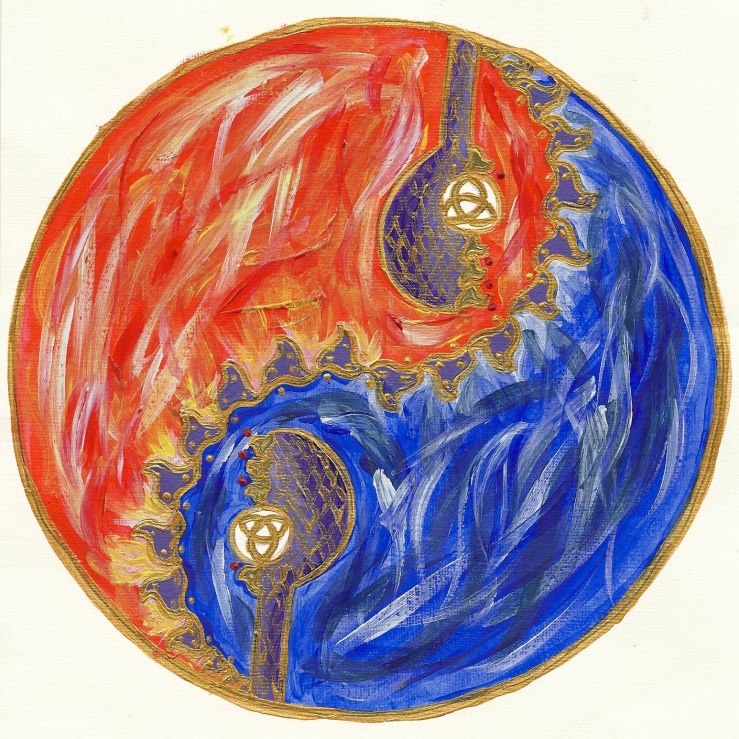
So, enough talk of that and onto spiritual consolation, I have long understood that God uses everything about where we are and who we are to draw us closer to Himself, to transform us into who He would have us be. Our role in this process is our cooperation. A persistent theme for me in my spiritual journey is integration, to reconcile the fire and water, active and contemplative parts of my personality, or rather, to allow the flow from one to the other without the resistance and negative feelings about that resistance that go along with the change of state. Since writing about Tai chi and Three Kinds of Humility in February, the momentum of this developing theme has increased in my discussions with my own director, and through lockdown, where I found that I really enjoyed working at home. It has been:

…the question that drives us (me)

Trinity, The Matrix
Integration 3: Reading of this post.

For me, the question is:

How do I live here, in my house with God, as He would have me live?

As it turned out, being in retreat at home, talking to a spiritual director every day, was the perfect opportunity to thoroughly explore that question. Prior to lockdown, I mostly tried to leave work at work, although inevitably, there were times I had to bring work home, there was a clear demarcation by virtue of physical location, between work and home. In my room, and in my prayer spot in particular, I had a clear demarcation between contemplative and active at home. During lockdown, I learned how to work at home, how to structure it to build time in between and to ensure that I do not overwork – I would identify obsessive workaholism as a danger for me. The structure was there, but how do I let go, and move from the active state to a contemplative state and vice versa? to allow the flow from fire to water and back to fire again? It took four days of turmoil of spirits during my retreat at home to let go of the responsibilities at home that were a constant distraction.

My Leviathan Mandala
Integration 4: Reading of this post.

It is the story of the two monks. To begin with, I was the scandalised monk, berating myself constantly, even though my desire was to be the other monk, the serene one, who had let go of the activity he had engaged in. Towards the end of the retreat, I had moved to be more like the serene one, although I have a long way to go still. How did it happen? In this retreat, I spent more time being active and “in the world” than I have ever done on retreat; I spent the least time in formal contemplative prayer than I have ever done on retreat, and yet a profound shift happened in my psyche which will reverberate as ripples in a pond throughout my life. It became clear, as observed by my spiritual director, that day to day life was not suspended in this retreat as it might be when I get in my car and drive away to a retreat centre as I normally do, that the invitation was to find God in All Things, as I live at home; more of a joined up, integrated way of being. The focus shifted to the transition. I noticed that, although I was active during my retreat, the activities I was engaging in were things that I just felt like doing: making candles, washing bottles, making aromatherpy blends for the oil burner, painting, even the odd job or bit of housework in the house. And I also went out and about, for dinner, for lunch – I would say solo, but I brought my icon with me and placed it discretely where I could see it. I was not alone.

My travelling Icon of Jesus.
Integration 5: Reading of this post.

The realisation gradually dawned: when I put some of these activities on my “to do” list, they felt like chores, and low priority tasks that my active “task girl” always put off as being not important enough compared with the other work I had to do today. They were also low priority for my “contemplative girl”, because they were not being still; contemplative prayer; formal time set aside to be just me and God. I recognised that these were activities that I did not set a definite time period for, they were finished when they were finished or I did not feel like doing them anymore. What was important, I recognised, was the movement within me as I engaged with them: I move from an active state of mind to a contemplative state of mind: flow. In the story of the two monks, it takes two hours for the berated monk to finally respond to the criticism of the other: there is a transition period. During lockdown, I had built into my day, time periods where I was away from “work”, but I struggled in how to use that time, other than to do more of what needed to be done and my mind was constantly racing over my to do list, and how to manage and accomplish the things that were on it. While being active with God on this retreat, I have come to know myself better and to stop berating myself for my apparent resistance to flow. It is not reasonable to expect to slow down from 120mph to 5mph instantly – it takes time. I would not expect it of anyone else, why should I expect it of myself, and then be frustrated that it does not happen like that? I also notice that moving the other way is less of a problem – turning the computer on, filling up my water bottle, checking emails, writing my “to do” list, are all activities that move me gently from contemplative and slow, to active and fast. I might criticise myself for displacement activities prior to getting down to work, but here, now, I am recognising that they are transtion activities.

Transition activities are the missing jigsaw piece that links the two aspects of my personality, that assist the flow from fire to water, and back to fire again. You might be reading, and thinking that it is just mindfulness that I am talking about, and that it might seem a bit obvious. It was not obvious to me until recently. Teresa of Avila describes it as:

Finding God in the pots and pans.

Teresa Avila: The Interior Castle

And I would not necessarily disagree with you that it is mindfulness, except to say that I am coming at it from the other direction, in terms of cause and effect. Rather than focusing my awareness on being mindful of the activity I am doing which results in bringing me into that meditative state, I am focusing on the activity I am doing which results in a state of mindfulness and brings me into that meditative state. For flow to happen, activities are well within one’s capabilities so as not to impede or block engagement, and also present with a little bit of challenge to motivate and interest. In trying to live at home with God this week, my understanding of how to live at home with God has deepened, and I put several transition activities on my daily to do list. It is not my intention complete them as tasks that day, merely as a stimulus. When I come to a transtion period in the day, I look at those things on the list and ask myself:

What do I feel like doing right now?

And I choose based on what I feel, maybe even something I have not written down.

Reflecting on my week of retreat at home I am grateful. Is it not generous that He gives us the graces we ask for, even – and maybe even especially – if not in the ways we envisaged when we ask for it? It reminds of the scene with Morgan Freeman as God, in Evan Almighty:

Integration 6: Reading of this post.

So, here is my challenge to you. What graces have you been asking God for in prayer? And do you notice the opportunities for those graces in your life? If, like me, there is tension between your active and contemplative sides, your Martha and Mary, as it is somethimes described, what are the transition activites for you? those things that facilitate moving from one state of being to another? If you feel like sharing…please post in the comments.

IGR 2020

IGR 2020 1: Reading of this post.

I made my first eight day individually guided retreat in 2001 at Loyola Hall. I have been writing about my journey from that point in the Diary of a Sunflower. It was a lifetime ago, and I feel like a completely different person now compared to who I was then. My retreat this year, which was booked for next week at St. Beunos in North Wales, has been cancelled due to the pandemic, and this will be the first summer since that first retreat that I will not have gone away to spend eight days in silence with God, as I promised all those years ago. It would be easy to be upset about it, but to be honest, I was not surprised by the cancellation and I have accepted it. I am still going to do a retreat this week, at home, starting today, Sunday, and I have found a director who will meet with me online every day.

I have to say, doing spiritual direction online, both giving and receiving, has been one of the wonderful surprises of lockdown and I would never have imagined it to work as well as I have experienced it. So much so, that I am intending to expand into giving spiritual direction online as a matter of course from September, regardless of any lockdown situation or easing, so watch this space!

I have reservations about all the distractions at home of course, and since my daughters live with me, complete silence might be an issue. But, they are prepped and cooperative, and I can go into my room and shut my door. I have room to sit and be, and a prayer corner in there. I have prepared meals in the feezer, and my laundry done, and I have a garden. My computer will go in the drawer, and I will have my artboard on my desk instead.

Ditchingham Convent Church
IGR 2020 2: Reading of this post.

While the nitty gritty of my preparations are probably uninteresting and do not really need to be shared, the point here is that I am creating a space – physical and psychological – to encounter God, to spend some time in deep with Him and away from all the distractions, and I am creating an environment that is conducive to that process. It is the principle described from the sixth to the ninth additions of the Spiritual Exercises:

I should not think of things that give pleasure and joy, as the glory of heaven, the Resurrection, etc., for if I wish to feel pain, sorrow, and tears for my sins, every consideration promoting joy and happiness will impede it. I should rather keep in mind that I want to be sorry and feel pain. Hence it would be better to call to mind death and judgment.

The Spiritual Exercise of St. Ignatius of Loyola, trans Louis J Puhl

For the same reason I should deprive myself of all light, closing the shutters and doors when I am in my room, except when I need light to say prayers, to read, or to eat.

The Spiritual Exercise of St. Ignatius of Loyola, trans Louis J Puhl

I should not laugh or say anything that would cause laughter.

The Spiritual Exercise of St. Ignatius of Loyola, trans Louis J Puhl

I should restrain my eyes except to look up in receiving or dismissing one with whom I have to speak.

The Spiritual Exercise of St. Ignatius of Loyola, trans Louis J Puhl

Ignatius gives these additions on the context of the First week, when we are contemplating sin and the grace we are asking for is sorrow and shame for our sins. The general idea is to make our enviroment conducive to our prayer.

So, here I am, I have finished my work for a bit and prepared my environment and my mind to spend this time alone with God in these unusual circumstances. I am up to date and taking a pause from my Journey with Julian of Norwich to be open to the process with the director. Am I concerned about distractions? about the world crowding in? Yes I am, and I am already prepared for how I might handle that. It comes in the form of a story in Anthony de Mello’s book, The Song of the Bird, called The Monk and the Woman:

Two Buddhist monks, on their way to the monastery, found an exceedingly beautiful woman at the riverbank. Like them, she wished to cross the river, but the water was too high. So one of the monks lifted her onto his back and carried her across.

His fellow monk was thoroughly scandalised. For two hours he berated him on his negligence on keeping the rule: Had he forgotten he was a monk? How did he dare touch a woman? And worse, carry her across the river? What would people say? Had he not brought their holy religion into disrepute? And so on.

The offending monk patiently listened to the never-ending sermon. Finally, he broke in with:

Brother, I dropped that woman at the river. Are you still carrying her?

Glennfinnan Viaduct, Scotland
IGR 2020 3: Reading of this post.

So, I will not be despondant that this is not the ideal situation in which to make my retreat: I will not listen to the desolating voices seeking to disrupt this time and I will not hold on to the noise around me, or the distractions, or any interruptions, if my daughters do not quite understand and ask me something, or if I have to answer the door. I am doing all that I can to be available to the One who loves me as if I were the only person in the whole world, and if it is enough for Him, it is enough for me. I am looking forward to it as much as I have any other retreat.

I will see you on the other side. There will be no Journey with Julian or Reflection next week, but the Prayer and the Diary entries are already scheduled, and I will be back to normal after next Sunday.

Ask a Spiritual Director.

I am planning a feature in future posts, to “interview” some spiritual directors I know, and possibly to feature contributions from them by way of blog posts. This is an idea in its infancy, and to be developed. As a first step, my request is of you to put forward questions you would be interested in asking a spiritual director. My intention is to offer the directors twenty questions for them to choose ten to answer for the feature. So, as an example, my question might be (and indeed, has been):

When people ask you “What does a spiritual director do?”, how do you respond?

I will interview myself first to try it out and because I wouldn’t ask anyone to do what I am not willing to do myself. So, if you have a question you are curious about regarding spiritual direction, or prayer, or God in All Things, or Spirituality…and so on, please put it into the comments and I will begin to put together my questionnaire, and my own repsonses. I look forward to hearing from you, and to pondering your questions.

Labyrinth Garden

Labyrinth Garden 1: Reading of this post.

Abundance. That is the word that comes to mind whenever I go out into my garden. It is so abundant in fact, that I simply cannot keep up with it! It reminds me of a scene from “The Shack” where Mack goes into the garden to talk to Sarayu (The Holy Spirit):

Labyrinth Garden 2: Reading of this post.

I have not always been a gardener. It is something I have picked up out of necessity in the last few years. I dug over the top third of my back garden about four years ago, thinking that if I planted a wild flower garden, it would take care of itself a bit, that I would not have so much grass to cut and it would make life a bit easier. I could not have been more wrong! The first year was absolutely splendid – and I missed a lot of the summer being away doing The Spiritual Exercises. After that, I was ill for about a year and nettles encroached, trying to reclaim it for themselves. I spent the last two years claiming it back, and this year has been maintenance, in that respect.

I have learned a lot in my time spent in the garden. The first, and most important lesson I learned is that I am not in control of it. I may have gone out there with a plan, but in no way has it happened the way that I thought it would. There are plants I have not seen since the first year I planted them – the scarlet pimpernel, for example. Such beautiful little flowers, I see why they are called elusive.

We seek him here, we seek him there,
Those Frenchies seek him everywhere.
Is he in heaven?—Is he in hell?
That demmed, elusive Pimpernel.

Sir Percy Blakeney, Baronet (ch.12); The Scarlet Pimpernel Baroness Orczy

I discovered during that first year that the best time to catch them with the flowers open was mid morning, so I took to taking my coffee break (I still call it that, even though I now limit my one coffee a day to breakfast time) at the top of the garden, looking for the scarlet pimpernel.

Scarlet Pimpernel – close up from the Spiritual Direction Mandala.
Labyrinth Garden 3: Reading of this post.

I generally left things alone for a while, to see what they would do, and I gradually became able to discern the difference between a plain old bramble, a raspberry and a blackberry. I did not plant any of these, but, there they were, in abundance. I am not so cavalier as Sarayu in removing things; in fact, I am as shocked as Mack is at the way she attacks that flower bed with such gusto, and I am tentative, but gradually becoming less so, about uprooting plants in my garden.

The strategy of waiting to see has paid off though. In the first year, as I was walking down the lanes near my house, I noticed some thistles growing on the verge at the side of the road. Being my national flower, I am quite partial to thistles, but I did not recall ever seeing their seeds on sale in the garden shops, and I wondered how I might get some in my garden. A few weeks later, I was sitting on the bench in the wild flower garden and I noticed that that spiky plant I had left alone was a big thistle and it was in flower. This was the second thing that I learned about gardening, that you get presented with many unexpected gifts. My garden has been growing trees – from scratch. As far as I can identify, beeches, hornbeam, black poplar and elderflower. These are challenging, problematic gifts because there is not the space for them there, from their perspective and mine, but what to do about it? I sat on that problem for months, until I noticed that some of them were lined nicely and could form a hedge, delineating the footpaths I have been putting in to prayer spots at the edges. I moved some of the others to form a little grove, leading to a meditation point, and I am coppicing them to form a hedge. I only lost three out of sixteen that I moved. I also planted some sunflowers in the first year, and those were glorious.

Spiritual Direction Mandala
Labyrinth Garden 4: Reading of this post.

This was always meant to be a conversation between friends.

Why am I telling you about my garden? Some of you experienced gardeners might even be shaking your heads thinking:

What is she talking about? She really doesn’t know much about gardening.

And you would be absolutely correct to think so. But I am not really talking about gardening: I am talking about the spiritual journey. Sometimes in our spiritual lives, something begins to emerge, fresh shoots, and we may not know what it is at first. It is like the darnel and the wheat, or in my case, the brambles, the raspberries and the blackberries, the thistles and the trees. God gives graces and gifts freely. Some of these, we desire, and maybe do not even know that we desire them -for me, the thistles. Some of these gifts and graces may be problematic, and we have to sit with them, to work through what it is He is giving, and what He would have us do with them – the trees. Some may be gifts we deliberately asked for, but we have to simply be, and at the right time, in the right place, we will notice their flowering – the scarlet pimpernel. And the sunflowers? Sometimes He gives exactly what we ask for and in the most generous and exuberant way. There are also times to uproot what was there before, even if it seems good, in order to prepare the ground for new growth. We may see a mess on the ground, but from the viewpoint of God, as Sarayu says, of the garden and of us:

Wild, wonderful and perfectly in process.

The mandala I have featured here is an assignment I did in the second year of my formation as a Spiritual Director. I have added the assignment as a page in its own right. It is too long to include everything I have learned since my initiation to gardening. As a celebration, particularly relevant since the churches have opened again in the United Kingdom this weekend, I offer this joyful prayer, featuring some of God’s abundant gifts as they appear in my garden.

I Am Not Alone.

I Am Not Alone 1: Reading of this post.

I have been walking quite a difficult path for a while now – you know, one of those rocky paths where there are stones and potholes where you could easily turn over on your ankle; or it narrows until there are thorn bushes on one side and a precipice on the other and it is a very tight gap to negotiate through. And of course, this path is uphill. There are interludes along the way: green, grassy valleys, flower meadows and cool fresh streams to drink, rest and bathe in. These nurture points are all appreciated with a deeper gratitude because the rest of the way is difficult.

So on this journey one day, I came around a sharp bend to a fork in the path. My feet were sore and blistered inside my boots from the walking I had already done, and my back was aching and my knees buckling with the weight of the rucksack I was carrying. I stared in dismay at the fork in the path: I had no idea which one to take. It mattered which one I took, because, while both were difficult and painful to travel by, the wrong one was treacherous, and not just for me. The problem was, I did not know which path was the wrong path, they both seemed as dangerous as each other.

“Discernment”: Path to the Rock Chapel at St. Beunos.
I Am Not Alone 2: Reading of this post.

In the Rules of Discernment in The Spiritual Exercises, St Ignatius uses metaphor to describe the different ways the evil spirit works. Of one he says:

The conduct of our enemy may also be compared to the tactics of a leader intent upon seizing and plundering a position he desires. A commander and leader of an army will encamp, explore the fortifications and defenses of the stronghold, and attack at the weakest point. In the same way, the enemy of our human nature investigates from every side all our virtues, theological, cardinal and moral. Where he finds the defenses of eternal salvation weakest and most deficient, there he attacks and tries to take us by storm.

The Spiritual Exercises of St. Ignatius trans. Louis J. Puhl S.J.

As I stood at the fork in the path, my castle came under attack, sustained and violent. I was bombarded with flaming canon balls, pressuring me to make a choice, telling me that the wrong choice would cause a catastrophe from which there would be no coming back and would have serious implications for those I loved. Those critical voices told me that it was all my fault, that I was worthless, and that any fallout from this decision was down to me, and in fact that there was a decision here at all was all my fault anyway because I had made mistakes in my past. Those critical voices told me that there was no time to waste, that I had to make a decision and make it quickly, because every second of delay only made it worse. Perhaps you know what I mean because you have been in a similar situation yourself?

Bodwellian Castle, Wales
I Am Not Alone 3: Reading of this post.

I remembered an image from a story I had been reading as a child. There was a Buddhist monk sitting meditating, breathing gently through a pipe or a rolled up piece of paper because he was covered in bees. The image I had of myself at this point, while trying to decide which path to take was very similar, but the bees were wasps, and I am a little phobic about wasps. Whenever one comes into my house I open the rest of the windows and leave the room, coming back later in the hope that it is gone. If one comes onto my classroom I make an incredible effort to remain calm and not show the rising panic inside me by asking one of the students to try to remove it, thanking them for being so helpful when they do. As I am sitting in this image, the wasps are calm and crawling, and as I become aware of the rising panic within me they begin to buzz around, making me feel even more fearful. Such was the anxious fear, the desolation at being faced with choosing one of these two paths.

Ignatius advises that we act against the desolation when we are aware of it, and that speaking to a spiritual person, such as a spiritual director, who is well versed in the art of discernment can help:

But if one manifests them to a confessor, or to some other spiritual person who understands his deceits and malicious designs, the evil one is very much vexed. For he knows that he cannot succeed in his evil undertaking, once his evident deceits have been revealed.

The Spiritual Exercises of St. Ignatius trans. Louis J. Puhl S.J.

So, I resisted the pressure to choose quickly, and I spoke to my spiritual director and to another person I knew who was an expert in dealing with the type of situation I was facing. At the end of it, the responsibility for the decision was all mine. So, I sat down at the fork in the path and I prayed:

I Am Not Alone 4: Reading of this post.

In the First Principle and Foundation of The Exercises Ignatius suggests:

…we must make ourselves indifferent to all created things, as far as we are allowed free choice and are not under any prohibition. Consequently, as far as we are concerned, we should not prefer health to sickness, riches to poverty, honor to dishonor, a long life to a short life. The same holds for all other things.

Our one desire and choice should be what is more conducive to the end for which we are created.

The Spiritual Exercises of St. Ignatius trans. Louis J. Puhl S.J.

For me, when I made The Exercises, this moment of indifference came when I imagined myself sat on a chair in the middle of a white, hexagonal room with six doors. Behind three of the doors were darkness, secrets and indiscernable material things, and fear: behind the other three doors were the three persons of the Holy Trinity. I was alone in the room and I had come there because He had called me. When I came into the room and saw that He was not there, I knew and trusted that He would come, no matter how long it took. So, I sat in the chair and stilled myself. I placed my palms upwards and said into the room:

I will wait.

And the moment I let go of all my preferences, and waited for Him in complete trust, He was there beside me; I was not alone.

They say, they being people who are experienced in working with The Exercises, that the graces received when we make the Exercises are always there. I would assert this to be true based on my own first hand experience. So, I sat down at the fork in that stony path and I prayed both with the song and in silence, and I put myself back into the hexagonal room, connected with that sense of indifference I had felt at the time and told Him the same thing:

I will wait.

I was not alone, and I knew it. I was affirming it to myself, to Him, and I was asserting it to the world. The critical voices were silenced and the wasps stopped buzzing. It is to deal with desolation as Ignatius suggests:

On the other hand, one who suffers desolation should remember that by making use of the sufficient grace offered him, he can do much to withstand all his enemies. Let him find his strength in his Creator and Lord.

The Spiritual Exercises of St. Ignatius trans. Louis J. Puhl S.J.

And I waited. I remained in this place, still, for over two weeks in real time. Not so long in God time. Gradually, a sense of knowing emerged from deep down, and the certainty of it strengthened as I remained there in stillness. The decision was made, and I knew which path to take. There was serenity in that decision, and an affirming smile from God. So I followed the path I had been shown.

Cross along the path of Peddars Way, near Swaffham.
I Am Not Alone 5: Reading of this post.

In the Lectio Divina for Psalm 16 it says:

You will show me the path of life.

Psalm 16:11

and praying with Julian of Norwich where the psalm fragment suggested is from Psalm 139:

…and lead me in the way everlasting.

Psalm 139:24

And last week I was writing about consolation and desolation. I have been pondering these things. Deepening trust in God is a theme that seems to be surfacing, especially when things get tough. Months after I followed through on my choice there was no disaster and a verbal confirmation that demonstrated that I had made the right choice from someone who knew nothing of my choice or my struggle, and who would have been badly affected had I made the wrong choice. I was immediately both grateful and humble at the impact my trust and faith in Him had had in real time.

When the situation is difficult and there is turmoil of spirits, it can be confusing to see which way to go. In the First principle and Foundation, we are encouraged to become indifferent to moving one way or another, to wait and to listen for what God would have us do. We are encouraged to trust in Him to show us the way and for that, we must be still and patient.

What brings you to life?

What brings you to life 1: Reading of this post.

I came that they may have life, and have it abundantly.

.John 10:10b

As you walk into my school, this quote from John 10 is written on the front of reception and it is regular referred to in day to day school life. It is our motto. And it is used as a reference point and to back up what we do and why we are doing it. There are a lot of underlying assumptions when it is invoked, and as a spiritual director, I find myself sometimes challenging those assumptions, at least internally, if not explicitly. We see in the gospels where Satan tempts Jesus in the desert that Satan is also an expert in scripture and quotes it in order to justify his own ends. The full John 10.10 quotes is:

10 The thief comes only to steal and kill and destroy. I came that they may have life, and have it abundantly.

John 10:10

To my ears and understanding, Jesus is eloquently summing up spiritual consolation and spiritual desolation. Ignatius takes a few more words to explain it:

Spiritual Consolation. I call it consolation when an interior movement is aroused in the soul, by which it is inflamed with love of its Creator and Lord, and as a consequence, can love no creature on the face of the earth for its own sake, but only in the Creator of them all. It is likewise consolation when one sheds tears that move to the love of God, whether it be because of sorrow for sins, or because of the sufferings of Christ our Lord, or for any other reason that is immediately directed to the praise and service of God. Finally, I call consolation every increase of faith, hope, and love, and all interior joy that invites and attracts to what is heavenly and to the salvation of one’s soul by filling it with peace and quiet in its Creator and Lord.

The Spiritual Exercises of St. Ignatius trans Louis J. Puhl S.J.

Spiritual Desolation. I call desolation what is entirely the opposite of what is described in the third rule, as darkness of soul, turmoil of spirit, inclination to what is low and earthly, restlessness rising from many disturbances and temptations which lead to want of faith, want of hope, want of love. The soul is wholly slothful, tepid, sad, and separated, as it were, from its Creator and Lord. For just as consolation is the opposite of desolation, so the thoughts that spring from consolation are the opposite of those that spring from desolation.

The Spiritual Exercises of St. Ignatius trans Louis J. Puhl S.J.

Consideration of these points lead to discernment questions in spiritual direction, either internally or externally:

Where is this coming from?

Where is it leading to?

Is this life giving? How?

Is this death dealing? How?

What is the more life giving choice here?

A preliminary understanding of life giving is around what makes you feel good, or happy. Elle, in Legally Blonde sums it up neatly:

What brings you to life 2: Reading of this post.

Ignatius does list interior joy as one of the effects of spiritual consolation and the sense of contentment might be considered manifestations of peace and quiet. It is a simple equation that Elle describes: sensible consolation = spiritual consolation, where sensible consolation is about what makes you happy: it must be good then, right? Brooke is a happy person, therefore she is not likely to have committed the mortal sin of murder. And then, must the opposite be true? If it doesn’t feel good, if it makes us feel unhappy and sad, sensible desolation, then it must be bad: sensible desolation = spiritual desolation.

But the equations are not that simple. Ignatius defines spiritual consolation and spiritual desolation in terms of whether something leads us towards God, or away from God: it is not about feeling good or bad, it is firstly, noticing what we are feeling and then observing what is prompting that particular emotion, and where that leads us, in terms of our relationship with God. Consider the recent journey through Holy Week and the Passion of Jesus. The third week of the Spiritual Exercises aligns with this journey and the grace that Ignatius encourages us to ask for is:

Here it will be to ask for sorrow, compassion, and shame because the Lord is going to His suffering for my sins

The Spiritual Exercises of St Ignatius trans Louis J. Puhl S.J.

Sorrow, compassion and shame do not feel good: to feel these things is heartbreaking and brings “copious amounts of tears” as Ignatius writes frequently of his own prayer. Notice above (in bold), he has listed tears that move one to the love of God as spiritual consolation. The world seeks to fix sorrow and shame, and perhaps even overwhelming compassion for another which leads to tears, considering these things as pathological. I’m not saying that this may not sometimes be true: I am saying that sometimes these emotions are appropriate, and when they are leading to a deeper love of God, then they are spiritual consolation.

Water Lily, Plantation Gardens, Norwich
What brings you to life 3: Reading of this post.

And sometimes, it is that simple: what makes us feel good is also leading us to God, and when we feel bad it may be because something is leading us away from God. The latter might be manifested as the “sting of conscience”. For example, perhaps I might feel bad about having gossiped unpleasantly about someone behind their back and I would identify such gossip as spiritual desolation, and the unpleasant sting of conscience the consolation inviting me to turn back to God.

Gerry. W. Hughes says On Desire:

If I were Satan’s advisor… I would suggest that Satan ensures that Christian leaders emphasise the danger of human desire, and the need to subject it totally to the will of God, constantly warning their flock that anything they desire must be rooted in their own selfishness, which they must constantly oppose. This will ensure that they always feel bad about feeling good….

God in all Things, Gerard W. Hughes

I remember a teaching colleague once said:

I’m not designed for this.

and while I cannot remember the exact context – they may have been asked to teach a subject they had not trained in (it happens) – I do remember thinking what a brilliant way of expressing their dissatisfaction about it; the idea that we are designed for something, a purpose, and the desire for that purpose is written into our design: it brings us to life when we are fulfilling that purpose, our own personal vocation, both in the big things of the election, our state in life, and in the little day to day things which help us to fulfill that election. The spiritual consolation is that what we do is in the praise, reverance and service of God.

The Psalm this week says:

You show me the path of life.

Psalm 16:11

In thinking about all of these things, and the slow burn of Easter Sunday, The Upper Room and lockdown, I’ve been considering the question posed at the top of the post. What does it mean for me?

Julian of Norwich considers that there are only two sins (sin being spiritual desolation, what leads us away from God): anxious fear and despairing fear or, want of faith and want of hope as described by Ignatius. Ignatius believed that ingratitude was the root of all sin. (Reimagining the examen App: Gratitude). These are a few of the key ideas and also Just for Today, that I am holding onto during this period of lockdown when it would be easy to succumb to fear, despair and anxiety at the state of things. I have myself a list of things that I know are lifegiving for me and I check it off every day (mostly) which reminds me to be grateful for the many blessings in my life and which challenges me to maintain my conscious contact with God.

My “Rule for Living”; to moderate my inordinate desires and unhelpful compulsions, and try to keep my focus towards God.
What brings you to life 4: Reading of this post.

Certainly, some of it is about endorphins and feeling good, and I might go for exercise or a hot bubble bath with candles and music (usually something spiritual), or even sleep, especially when I feel that creeping darkness weighing on my spirit. Self pity is a particularly distasteful manifestation of ingratitude and it is something I cannot stand within myself whenever I notice it.

Candle holder.
What brings you to life 5: Reading of this post.

So here are my questions for you:

How are you doing right now?

What are the things that bring you to life?

My suggestion is that you make a list of these things and put it on the fridge or somewhere prominent so that the next time you notice that creeping desolation within you, you already have a range of strategies to help you to act against it – all you have to do is choose one and do it.

Dancing with God

Dancing with God 1: Reading of this post.

I learned some ballroom dancing when I was a university student and one of the most memorable moments of that dancing was at the social “practice” evening. I was about eight lessons in, and had only just learned the basics of the waltz, with the pivot turn being the subject of the previous lesson, when they played a “snowball” waltz. The way it works is that a couple, who were partners on the university team, would waltz for a bit, and then they would separate and each choose a new partner from the crowd gathered around the floor. This process would continue until everyone who wanted to dance was on the floor. After a bit, I was asked to dance by a PhD student, a few years older than me, who was part of the University dance team and from my perspective, a phenomenal dancer. As we got onto the floor, the music stopped and the DJ put on a new song: this one was a Viennese waltz! I was horrified. I told my partner that I was just a beginner, and that I did not know this dance. He smiled softly, told me just to relax and follow him, that it was his job to lead me, and asked me to trust him. I struggled for a bit, trying to work out what to do, to anticipate what the next steps were and I could feel the tension in my body as it put up some resistance. That is until a few bars in when it clicked – I did not have a clue, why was I trying to work it out? He knew what he was doing, all I had to do was stop trying to control where we were going, to stop over thinking it, and to give myself over to him in cooperation and trust. So I did. The next few minutes were absolutely amazing, and forever imprinted on my soul: I learned to trust, I learned to follow, I learned to dance. We went whizzing round the floor, round and round, then slow on the spot almost, and then round and round in the other direction: I was giddy, breathless and euphoric. It occurred to me how fantastic this was, and immediately I became self aware, my right heel caught in the front of my left shoe and we both went sprawling across the floor. My partner got up and offered his hand to help me up saying:

I am so sorry, that was my fault. Please forgive me.

I tried to tell him that it was really all mine, but he would not hear of it. And then it was time for us to change partners again.

The Plantation Gardens, Norwich
Dancing with God 2: Reading of this post.

Of desolation and consolation in the Exercises Ignatius says:

He who enjoys consolation should take care to humble himself and lower himself as much as possible. Let him recall how little he is able to do in time of desolation, when he is left without such grace or consolation.

On the other hand, one who suffers desolation should remember that by making use of the sufficient grace offered him, he can do much to withstand all his enemies. Let him find his strength in his Creator and Lord.

The Spiritual Exercises of St. Ignatius trans Louis J. Puhl S.J.

Dancing with God, in a variety of different ways, is a frequent theme of consolation in my prayer. I have stored up many, many memories of dancing with God in my prayer life which sustain me when the going gets tough. As when dancing with the PhD student above, I have to relax, cooperate and trust, to let God lead and to follow where He leads. When I do it allows the flow and the magic happens. When I hold back, when I resist and try to control the movement, it is stilted and laborious. Dancing with a partner in this way is about relationship, communication and sensitivity; it is about call and response. In his book, The Divine Dance, Richard Rohr says:

Now we are prepared to say that God is not, nor does God need to be, “substance” in that historic Aristotelian sense of something independent of all else but, in fact, God is relationship itself.

The Divine Dance, Richard Rohr

He attests that the relationship is the vehicle, and of metaphor he quotes the Canadian writer Donald Braun :

That which is belittled in plain speech finds the respect it warrants in the subtleties of metaphor.

The Journey from Ennuied, Donald Braun

In the inner experience of my prayer, dance is indeed an excellent metaphor for my relationship with God.

Dancing with God 3: Reading of this post.

For example, I was always very comfortable, familiar and friendly with Jesus and although there was a “God the Father”, who I just called God, He did seem very far away and formal, and the Holy Spirit, well, to be very honest, I did not really have much idea what the Holy Spirit was like at all: ethereal, intangible, mysterious – who can get a handle on the Holy Spirit really? And then on one of my annual retreats, I bought my little traveling icon of Rublev’s “The Hospitality of Abraham”, AKA The Holy Trinity, and I started to have it in front of me every day while I was painting mandalas. Over the retreat I began to realise that I did know the Holy Spirit, and that I had always distinguished between Jesus and the Holy Spirit. It was the scene from the film “The Prestige” that surfaced in my mind that made this revelation to me:

Dancing with God 4: Reading of this post.

Here, Sarah is not consciously aware that it is not her husband she is talking to, but his identical twin brother. Her husband is the one lifting their daughter away from the argument, ostensibly Alfred’s assistant. They are living their trick, and not even the respective loves of their lives are in on it. Earlier she had said to him:

Some days I think you love me, and some days I think you don’t.

Or words to that effect. So here, when he answers her:

No, not today.

he is being very honest, because he is not her husband. Her husband does love her.

What was it that this scene revealed to me? While Sarah might not have been conscious of it, she was able to perceive differences between her husband and his identical twin (and she did not know there was a twin). It dawned on me that sometimes in my prayer journal I wrote “Jesus” and sometimes I wrote “JC”, and I always had done, even when I kept a diary as a teenager. I realised that I was intuiting subtle differences in the aspect of God that I was perceiving from my prayer, and that I was distinguishing between Jesus and the Holy Spirit. Some people I know do not experience the Holy Spirit as a person, but I definitely do. JC is what I call Him by.

This revelation made God the Father seem even further away than before: I had in mind those distant, English Victorian fathers, of the sort depicted in Mary Poppins. When I talked to the spiritual director guiding me on my retreat about this, he suggested that I ask the Father in prayer, what He would like me to call Him. When I did, He asked me to call Him by His name:

The most personal name of God revealed to Moses, and treasured as a sign of intimacy and favour.

Theological Glossary, The New Jerusalem Bible

And He invited me to slow dance: He invited me into intimacy with Him. Suddenly, He was not so far away, but up close and personal as in the picture featured at the top of the post. I could sense His strength, incredible strength, and a poignant loneliness which touched me: even as He said with a deep longing:

I have waited for this moment for a long time.

Imagine, God is lonely for us! All of God is longing for intimacy with us. It is as Julian of Norwich says in Day 8 of the 40 Day Journey:

God’s thirst is to have [us], generally, drawn into Him…

40 Day Journey with Julian of Norwich, edited Lisa E. Dahill

In the Spiritual Exercises, through use of our memory and imagination in prayer, Ignatius invites us to experience and live with God and to grow into a deeper intimacy with Him. It is to enter wholeheartedly into the Divine Dance.

Another time I might tell you about morris dancing with the Holy Spirit, but for now I will leave you with a song that I understand God is especially fond of. Enjoy.