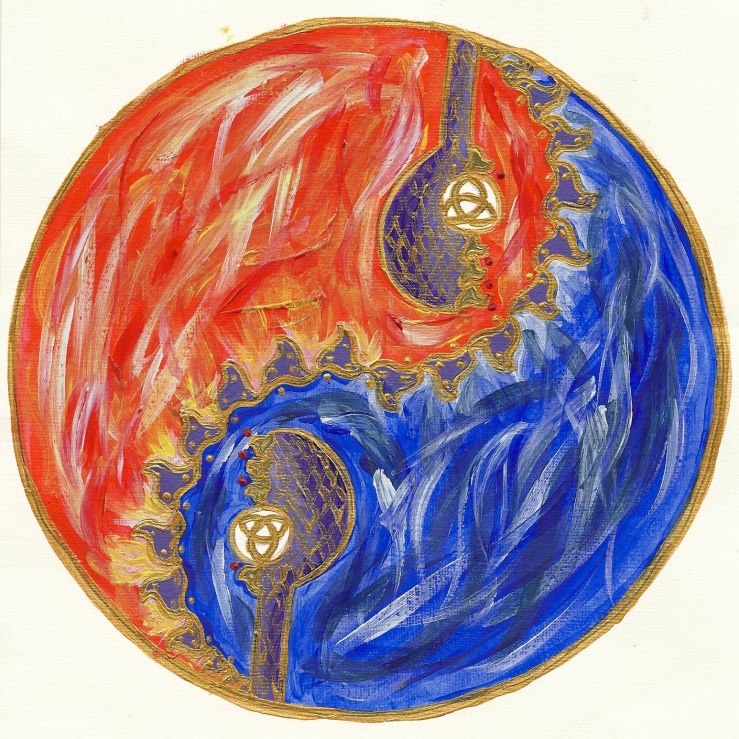
The seed of God is in us. Now the seed of a pear tree grows into a pear tree; and a hazel seed grows into a hazel tree; a seed of God grows into God. (Meister Eckhart)
Due to illness, the sessions of Exploring Personal Prayer were delayed after the Lectio Divina. We will be doing the session on the Examen tomorrow at 6.30pm GMT and you are welcome to come along, even if you have not attended any of the other sessions. The period we will be looking at is our Advent this year, and Christmas so far. I hope you will be able to join us.
December has been a very tough month this year. You might have fathomed that from my lack of posts. I have been trying just to make it to the end of term. Did I make it? No, not really. I was ill and had another negative COVID test, and then back to work for the last week and a bit, only to scald my face quite badly on the Wednesday and have to stay home on the last day of term, after a visit to Accident and Emergency. Not that it made any difference, since I received a phone call from the Assistant Head telling me not to come into school on the Friday because one of the students I taught had tested positive, our first confirmed case in school. They needed to double check protocols with Public Health England. It seems to change regularly. Since then, another two students and some teachers have tested positive too. It is easy to complain and make a list of all the negatives, but suffice to say, December has been tough, for lots of reasons.
I have been watching Peaky Blinders on DVD box set throughout this month…maybe I should nickname it “Bleaky Blinders”. It is dark. Since watching TV is one of my amber, desires – it tips over into inordinate desire and obsessiveness all too easily, my Spiritual director encourages me to notice what I am drawn to watch and why. What is it that draws me? Where is it coming from? and where is it leading to? All good discernment questions. If you know the series, you might recognise in the title for this post, the words the brothers are committed to saying at the point of death.
So, here is what I notice. I watch a lot of Films/Box sets when I am ill, stressed or exhausted. I have been all of these, all throughout this long, long month. When my head is caving in and my body is just fighting to do what I need to do, and crash when there is no necessity or even option. My head becomes a swirly place to be, and the escapism offers some relief from the constant noise. You may know what I mean.
I am drawn to complicated characters that demonstrate moral ambiguity. Tommy Shelby might indeed be a violent gangster, but he also has admirable qualities and vulnerabilities: he shows tenderness and is clearly tortured by his experiences of the First World war. What would he have been without that desolating experience? The most recent episodes I watched described a charming young man with a desire to change the world for the better. A different man came back from the war, and is still fighting it. He knows no peace and falls apart when his circumstances and environment are peaceful. I am not recommending Peaky Blinders here, I am noticing my response.
I also notice the feeling of restlessness and the impulse to turn it off. Is that the nature of the drama itself or the process of watching too much TV? Or both?
When I did turn it off a couple of evenings before Christmas, I put up my Christmas tree and played carols, I had to stop for about five minutes and cry. So many of the baubles bring with them their own memories of different Christmasses past. When I became a single parent, I bought a set of very cheap baubles for that first Christmas alone with my children, and we bought only two elaborate baubles that they each got to choose one. We did that every year, gradually replacing the cheaper ones, so that now it is an eclectic mix. They are not inclined ot put up the tree anymore, and because of Coronavirus, my friend did not come to stay this year: I decorated the tree on my own. It was a poignant experience, and moving.
Christmas has been quieter this year, not the huge pomp and ceremony as usual. It has been trimmed back. And yet, in the middle of this winter, where perhaps we still have as much to go through as we have aready been through, there is the cosiness of finding a safe place and hunkering down, in spite of the odds. It may be survival mode and if there is survival, there is life and recovery is possible. In the centre of this hard place, there is a light and hope: it is this truth that hit me while I was decorating my Christmas tree. As always, when we remember to look for the presence of God, He is to be found, no matter how long or bleak the winter.
I will run the Exploring Personal Prayer Advent course live on Saturday evenings during advent, with a an Introductory talk on the Spiritual Exercises. The sessions will be as follows:
Sat 21 November: Presentation on The Spiritual Exercises
Sat 28 November: Lectio Divina
Sat 5 December: Imaginative Contemplation
Sat 12 December: Praying with Images
Sat 19 December: The Examen
Iwill use zoom for video conferencing. In terms of payment, I have set up a donations page if anyone wants to support me in this work, with some suggestions and an “other” option. Please don’t let it be prohibitive, it is the work that is important. Registration is so that I can prepare properly for those intending to be there. Below is an outline of the course with the dates:
I will run the Exploring Personal Prayer Advent course live on Saturday evenings during advent, with a an Introductory talk on the Spiritual Exercises. The sessions will be as follows:
Sat 21 November: Presentation on The Spiritual Exercises
I will be making a decision on when to run this on WEDNESDAY, so if you want to contribute, please do so before then. Thank you.
It is my intention to run an Advent version of my Exploring Personal Prayer course live online. I would have the first session, a presentation on The Spiritual Exercises, in the week beginning Sunday 22 November, the week before the first Sunday of Advent. In each of the consecutive four weeks I would guide a session on Lectio Divina, Imaginative Contemplation, Praying with Images and the Examen respectively.
Here, I would like to gauge interest in such a course and find the optimium time to present it, so that as many people who want to attend can attend. You may want to, but know you are unable to commit to all of them: please do not let this deter you from joining the ones you can. I am also prepared to offer more sessions in the week, should there be sufficient interest.
Please complete the polls below if you are interested, to aid me in planning an appropriate time.
Please add anything else that you think would be helpful for me to know in the comments.
Thank you for taking the time to complete the polls, and I hope to see as many of you as possible. It would be lovely to put some talking faces to their names, and to meet and pray with you – albeit virtually.
Morris dancing with the Holy Spirit 1: Reading of this post.
The Jerusalema Dance Challenge on Facebook has been filling me with deep joy recently, especially this version of it:
Jerusalema Challenge from the catholic Cathedral of Montreal Music: MASTER KG – JERUSALEMA [FEAT. NOMCEBO]Morris dancing with the Holy Spirit 2: Reading of this post.
It reminds me of morris dancing with the Holy Spirit. Let me explain. There is surrender, and then there is surrender! One of the funniest things one of my friends has ever said to me on the subject of surrendering to God is:
I am surrendered to God! He drags me screaming and kicking to do His will!
(I am sorry, you know who you are, and it is too good not to share)
While it makes me laugh, it also illustrates what I am trying to say. We make partial surrenders and think that we are open, and doing what God calls us to do, when in reality, we are in denial about our own resistance. I read an analogy once that to surrender to God was like handing Him a signed, blank cheque that He could draw on; it is a promise, a commitment to give whatever was asked. I liked this analogy and had considered myself as having done just that for a long time. Little did I know that I was like Oda Mae Brown in Ghost:
Morris dancing with the Holy Spirit 3: Reading of this post.
Sure, He might claim on that signed cheque. Maybe we both knew and accepted that whatever He asked would be given, but like my friend I quoted above, I put up a good fight for someone who was surrendered. Perhaps at this point it is the state Ignatius makes the prayer at the end of the first week of The Spiritual Exercises:
Eternal Lord of all things, in the presence of Thy infinite goodness, and of Thy glorious mother, and of all the saints of Thy heavenly court, this is the offering of myself which I make with Thy favor and help. I protest that it is my earnest desire and my deliberate choice, provided only it is for Thy greater service and praise, to imitate Thee in bearing all wrongs and all abuse and all poverty, both actual and spiritual, should Thy most holy majesty deign to choose and admit me to such a state and way of life
We may have the desire to surrender, but it does not necessarily mean that we have completely surrendered.
To understand the difference, as I experienced it, let me tell you about the morris dancing. I really like dancing, I have used it as a metaphor for the relationship with God before, but morris dancing? nooooo…not my thing. If you are not familiar with the concept, and you might not be, it is an English thing as far as I understand it (Scottish folk dancing is quite different); here is an example:
Morris dancing with the Holy Spirit 4: Reading of this post.
Please understand, I have friends who do morris dancing, I am not mocking it, but it is definitely not for me. So with this in mind, there was The Song of Songs retreat the year before I did The Exercises. This retreat has its own name, out of the twenty or so I have ever done, because it was so significant. I had been praying with a passage from the Song of Songs as suggested by my spiritual director on the retreat and while speaking to him afterwards, I read out to him the colloquy from my imaginatve contemplation, which was pretty much a monologue from me. It was my own personal suscipe prayer:
My God, my God. I surrender everything to You, I surrender completely to You. I am lost to You, I am lost in You. I have given You my right to choose. I have no will but Your will, no choices but Your choices, no desires but Your desires, no strength but Your strength. I am completely dependent on You. I surrender everything.
As I read it out to the director, I slipped into silence as it dawned on me just what had happened, quietly and certainly in that imaginative contemplation: I had surrendered completely to God, nothing held back. I had admitted it to God, and now I was admitting it to myself and to another human being. My director also recognised the significance of it because he allowed the silence for it to sink in during my session with him and the next day, he gave me a copy of the Suscipe Prayer from The Spiritual Exercises. It was real. You cannot pray like this and not live it. And still, it had yet deeper to go. There was a subsequent imaginative contemplation towards the end of that retreat where I was standing with the Holy Trinity and we were watching some morris dancers. Please do not ask me why…such is the world of imaginative contemplation. The Holy Spirit invited me to join in the dance with Him, and I resisted, saying that it really was not my thing. He stood His ground, looked me straight in the eye and said:
I desire it.
My response to this expression from God is now, automatically:
It is given.
So I joined the Holy Spirit in the dance, while Jesus and YHWH were crying with laughter on the sidelines because the Holy Spirit had invoked the irrefusable request in order to go morris dancing with me. And yet, still I resisted, like Oda Mae, holding onto that cheque and being grumpy, even after it was handed over. I resisted, until I saw the expression of delight and pure, unadulterated joy on the face of the Holy Spirit when I was banging sticks with Him. He was stomping hard to make those bells ring loudly and He was just so happy. I realised that I was being churlish; that to join reluctantly was not surrender, I had to abandon myself freely to this dance, no matter how foolish I thought it was. It was the third kind of humility:
I desire to be accounted as worthless and a fool for Christ,
So I threw myself into the dance and Jesus and YHWH also joined in. No matter how difficult and dark things seem to be at times, the experience of being a part of this divine flow of joy still fills me whenever I recall it, five years later. In the Spiritual Exercises, regarding such spiritual consolation, St. Ignatius says:
When one enjoys consolation, let him consider how he will conduct himself during the time of ensuing desolation, and store up a supply of strength as defense against that day.
What I learned from morris dancing with the Holy Spirit is that to give up all resistance and to surrender joyfully and freely to God is the most liberating thing to do. It is a once and for all surrender, and an everyday surrender. It takes constant prayer, listening and discernment, and patience, to know that it is indeed God who is saying:
I desire it.
The irrefusable request, to which the only response is:
It is given.
And there is no need to beat ourselves up because we are not there yet. The Holy Spirit was full of joy simply because I had joined the dance, despite me being reluctant and grumpy about it. Each desire for, and each little surrender is a step towards complete surrender. It is the movement in The Spiritual Exercises from the Eternal Lord of All Things to the Suscipe Prayer:
Here, as stated before, it is my intention to draw from the forthcoming Sunday liturgy and to offer a guided prayer on one of the pieces of scripture in the same way that we have been doing in Exploring Personal Prayer. I do not intend to offer any reflections on the scripture. My suggestion is that you follow the Ignatian structure: preparation for prayer by reading the scripture, going to your prayer place and doing the prayer itself, and then moving away to another place and doing a review of the prayer. Keeping some sort of prayer journal is good practice. Note any moments of consolation in the prayer, where you felt drawn more deeply into God, and moments of desolation, where prayer was disturbed, where you were distracted and pulled further away from God: feelings of attraction and repulsion should be noted. These points may provide areas for repetition of the prayer. Also, if you have a spiritual director or prayer partner, someone who can listen with an ear to where God is in this, it may be worth sharing your prayer with them. I am following the processes outline in the prayer cards above. You may print these onto A6 or A4 card to have in your prayer space to help you become accustomed to this way of praying, remembering it is more of a flow than a rigid structure.
The Parable of the Wedding Banquet
22 Once more Jesus spoke to them in parables, saying: 2 ‘The kingdom of heaven may be compared to a king who gave a wedding banquet for his son. 3 He sent his slaves to call those who had been invited to the wedding banquet, but they would not come. 4 Again he sent other slaves, saying, “Tell those who have been invited: Look, I have prepared my dinner, my oxen and my fat calves have been slaughtered, and everything is ready; come to the wedding banquet.” 5 But they made light of it and went away, one to his farm, another to his business, 6 while the rest seized his slaves, maltreated them, and killed them. 7 The king was enraged. He sent his troops, destroyed those murderers, and burned their city. 8 Then he said to his slaves, “The wedding is ready, but those invited were not worthy. 9 Go therefore into the main streets, and invite everyone you find to the wedding banquet.” 10 Those slaves went out into the streets and gathered all whom they found, both good and bad; so the wedding hall was filled with guests.
11 ‘But when the king came in to see the guests, he noticed a man there who was not wearing a wedding robe, 12 and he said to him, “Friend, how did you get in here without a wedding robe?” And he was speechless. 13 Then the king said to the attendants, “Bind him hand and foot, and throw him into the outer darkness, where there will be weeping and gnashing of teeth.” 14 For many are called, but few are chosen.’
Imaginative Contemplation: Parable of the Wedding Banquest, guided prayer
Background music is the album: Keith Halligan – Lifestyle Meditation, Global Journey
Here, I am adding a new feature to my blog: interviews with spiritual directors. I am starting with myself, since I think I should not ask people to do something I am not prepared to do myself, and using questions I have been asked, or I have asked, or people have suggested I ask in response to my request for questions. I hope you find it enlightening, and if you do have other questions you would like to ask spiritual directors, please add them to the comments for this post.
Margaret Mary McFadyen: Ignatian Spiritual Director
When people ask you what a spiritual director does, how do you respond?
I always find this one a bit tricky and never really feel that I get it “right”, especially when I’m talking to people who don’t have a religious faith. I usually say that it is a bit like counselling, except that we talk about the person’s prayer life, their personal relationship with God and the way they live their faith. With non-believers, the usual response is for the eyes to glaze over; for believers who believe themselves do be doing fine in that department there is a polite nod or explanantion to that effect. Sometimes though, with other believers, it makes a connection within someone for more and they start to ask more questions, becoming more thoughtful. Often, these are the ones which will go on to seek ongoing spiritual direction in their lives – not necessarily from me, I hasten to add. I am not necessarily the most appropriate person for them.
What’s the difference between spiritual direction and counselling?
If I were to sum it up, and based on my own experience of receiving both – I have talked to counsellors during periods of crisis and stress in my life – I would say it is about the purpose and the effect. Even though spiritual direction might overlap a little with counselling, it is not the same thing. I would say counselling is when you are having trouble functioning “normally” in everyday life, when there are issues getting in the way of day to day living. Counselling can help us back onto our feet when we are in crisis. With spiritual direction, on the other hand, we may be ticking along quite nicely, working, living, socialising but we have a sense of there must be more to life than this. Spiritual direction helps us to focus more on those subtle nuances, to improve our day to day conscious contact with God, to deepen our listening and gently and gradually, we begin to live more intimately with God amd more in tune with ourselves, in what He designed us for. It is extremely liberating to live in this way, in my experience.
What made you become a spiritual director?
I would say it was a “first time choice” as St. Ignatius describes in The Spiritual Exercises. I was on retreat at St. Beunos one summer and during mass, at the quiet bit around communion, I was pondering my own spiritual director in life, and the director who was working with me on the retreat – both wise and gentle people who were making a difference to me. I felt a wave of gratitude for them, and for every other director who had contributed their wisdom to my faith journey, and I expressed this sentiment in a prayer. I then “heard” or “felt” the words whispered:
You could be a spiritual director.
I was immediately calm and curious, because I recognised that I had a desire to do that, even though it had never occurred to me before, and I knew who to ask about doing it.
How did you go about training to be a spiritual director?
My own director was involved with the Ignatian Spirituality Course which was running at The Centre for Spiritual Direction in Lombard Street in London. The course has moved to Mount Street recently. After sitting with the idea for a bit, on the second meeting with him after my retreat, I told him about my experience on retreat. I had a sense that his response might give me an indication of whether I would be a suitable candidate for the course or not. He beamed at me when told him about it, and responded very positively, which to me was very affirming. I had a few things to work out, like going part time in my day job and how I was going to finance it, but the rest is history as they say. I started the course at the next intake.
What is it that draws you to Ignatian Spirituality in particular?
I remember an adult of my parent’s generation in the church saying to me when I was a teenager:
It’s dangerous to think.
and I knew I didn’t agree with them; I vehemently disagreed with them. Silently, of course, because it would have been deemed as insolent if I had spoken out at that time. I was curious as a student, and well into chemistry at this point. There were more questions than answers, and the interest and questions were self perpetuating. St. Ignatius describes our reason, our ability to rationalise as the second power of the soul: he encourages us to engage our brains with our lived faith, not turn them off. I might not have known that explicitly, but I felt comfortable around Jesuits and enjoyed the sermons whenever I heard them because they stimulated my brain. Imaginative Contemplation is also something I really get into and I started to experience this form of prayer on retreats when I was a student. I’ve been told that I have a very vivid imagination, and this form of prayer connects me deeply to living with God. Ignatian spirituality suits my personality at the end of the day; I feel at home there.
What do think are the benefits to receiving spiritual direction?
Receiving spiritual direction raises our conscious contact with God. We become better at listening and noticing where God is calling to us, and our desire for God increases. It is a safe place to say things that we might not be confident about saying out loud, even to those we are close to, because it could invite critcism, or people think we are weird, or worse. If you say things like “I heard God say…” in the real world out there, it can be received with derision and hostility and that is not a safe environment in which to explore what is going on. Sure, the spiritual director might ask “How do you know it was God?” and that is an important part of the discernment process. They are not unbelieving in the idea that God speaks to us through our imagination, thoughts, dreams and experiences. Personally, at the beginning of my Ignatian journey, I found it difficult to talk about what was happening within me. I worked with sceptical scientists after all and even the fact that I believed in God was often regarded as a curious anomaly, even though it is not really that rare to believe in science and in God. Being able to open up about my personal relationship with God in spiritual direction, and to explore it openly and safely in this way, has literally changed my life and to find out who I really am and who I am created to be at a profound level. I would definitely recommend it.
When starting on a session or series of sessions with a client, do you like them to begin by talking about how they feel and what they are hoping for from the experience, or do you prefer to let this emerge gradually, perhaps with the help of imaginative prayer?
I always start my sessions the way my directee would like them to start. With most of them, they like to start with a prayer, so I use an informal prayer around the preparatory prayer and the presupposition of the Spiritual Exercises and the annotations, bascially asking for open and honest discussion, for each to presuppose the good intentions of the other, and for where there is a lack of clarity, to ask. I think this format is helpful in reminding us both of the purpose, and that if the communication is not quite flowing, that no judgement or ill is meant by it, and that asking for clarification is the way to go to open things up. When people are sharing deeply and of painful things, it is important to know that I am not sitting in judgement of them. I am aware that I can sound like my “teacher voice” and I furrow my brow when I am thinking, which can also leave people wondering if they have said something wrong! Not my intention at all, so asking for clarity is always open. Otherwise, I am there in service of my directee, so I allow things to emerge, and I will lead in an imaginative contemplation as appropriate, usually by prior arrangement.
Do you start your sessions with a prayer?
I do , as I said in the previous question, if that is the preference of my directee. Interestingly enough though, I do not like to start with a prayer when I am receiving spiritual direction. When the director does that, I feel that I have to be a “good girl” in the session, and it limits my expression of negative feelings and attitudes, thus not allowing me to explore deeply what is going on. Whenever that happens, my sense of the process is superficial. Fortunately, my director in life does not start our sessions that way and it has allowed me to fully explore the good, the bad and the ugly. God, after all, sees it all.
Why do you have supervision as a spiritual director?
At the very least, we pray not to get in the way.
Gerard W. Hughes, Loyola retreat, 2009
I was fortunate to go on this retreat that Gerry Hughes led in Loyola, and this is what he said about spiritual directors in his introductory talk on the first evening of the retreat. For me, it sums up the role of supervision. I have my own feelings, issues and biases – I am a human being, and some of these may be subconscious. The spiritual direction conversation is between the directee and God, and I am the channel that seeks to facilitate that conversation. Supervision helps me to be aware of what is going on inside me that might be helpful or detrimental when I am directing, so that I can adjust and maintain that position of equilibrium in order that God can work with the directee, without me getting in the way.
How do you feel about online spiritual direction?
Online spiritual direction has been one of the surprises of the pandemic for me. I was sceptical at first, thinking it would be better that nothing but I was dubious about how well it would work. I still believe face to face to be better, but in both receiving and giving spiritual direction online, as well as receiving supervision, it has changed my opinion. I think it has value in itself and may be the way forward for people who would like to receive spiritual direction, but live too far away from any directors to make it practically possible to travel. I travel for 2 1/2 hours to see my director and it takes up most of the day. Not everyone is able to do this, but online makes it possible, even for the busy working person or parent who might not catch a break until the evening. I’m excited about it as a possibility for widening the reach of spiritual direction.
Do you charge for spiritual direction?
I do ask for a donation in line with earnings. I firmly believe that the labourer deserves their wage, and that if the Levites were not sustained by the people’s tithes, they would not be able to look after the temple, but would have to be working in the market places and farms in order to live. I do pay my own director. It is very difficult, if not impossible, to make a living as a spiritual director. Most do it as part of a paid ministry, or have some other form of income – a day job. I teach in a school. I have directed people for free when I knew they were not in a position to pay. It is the work that is important after all. At the most, I hope to at least break even, after I have paid for supervision and ongoing CPD courses to support my work. Over the course of a year, I will generally have received more than I have spent.
If someone wanted to receive spiritual direction from you, how could they go about contacting you?
In my last post, I said that I was ready for my retreat at home – well, that was famous last words! It was certainly the most challenging retreat I have ever done, and the beginning of it, the most stressful. Not at all what I had prepared for or anticipated. I did not manage to get a food shop in after doing a lot of unexpected running around the day before, so, after speaking with my spiritual director on the first morning of the retreat, planned to do that, shower and then begin proper. Except that when I went out, my car had a flat tyre (I thought it wasn’t handling properly the night before – even though it did not look flat when I checked it, miles from any garage) and just as I finished changing the wheel, my neighbour decided that it was a good time to come over and be unpleasant, aggressive and threatening. I may have remained calm, reasonable and rational externally, but it caused no end of disruption to my internal serenity. I thought about the two monks I wrote about last time:
Brother, I dropped that woman at the river. Are you still carrying her?
And I am so glad that I did write that, because it was my hook through the week when I found my thoughts drifting to the conflict with my neighbour and the spiritual desolation that it brought. It pulled me up short and reminded me of where I really wanted my focus to be, so when I noticed that my thoughts had strayed, I turned my attention to the little icon of Jesus that I was carrying around and placing everywhere I was, and I brought to mind the consolations I have been storing up to help me in times of desolation.
When one enjoys consolation, let him consider how he will conduct himself during the time of ensuing desolation, and store up a supply of strength as defense against that day.
Ely CathedralIntegration 2 : Reading of this post.
So, enough talk of that and onto spiritual consolation, I have long understood that God uses everything about where we are and who we are to draw us closer to Himself, to transform us into who He would have us be. Our role in this process is our cooperation. A persistent theme for me in my spiritual journey is integration, to reconcile the fire and water, active and contemplative parts of my personality, or rather, to allow the flow from one to the other without the resistance and negative feelings about that resistance that go along with the change of state. Since writing about Tai chi and Three Kinds of Humility in February, the momentum of this developing theme has increased in my discussions with my own director, and through lockdown, where I found that I really enjoyed working at home. It has been:
…the question that drives us (me) …
Trinity, The Matrix
Integration 3: Reading of this post.
For me, the question is:
How do I live here, in my house with God, as He would have me live?
As it turned out, being in retreat at home, talking to a spiritual director every day, was the perfect opportunity to thoroughly explore that question. Prior to lockdown, I mostly tried to leave work at work, although inevitably, there were times I had to bring work home, there was a clear demarcation by virtue of physical location, between work and home. In my room, and in my prayer spot in particular, I had a clear demarcation between contemplative and active at home. During lockdown, I learned how to work at home, how to structure it to build time in between and to ensure that I do not overwork – I would identify obsessive workaholism as a danger for me. The structure was there, but how do I let go, and move from the active state to a contemplative state and vice versa? to allow the flow from fire to water and back to fire again? It took four days of turmoil of spirits during my retreat at home to let go of the responsibilities at home that were a constant distraction.
My Leviathan MandalaIntegration 4: Reading of this post.
It is the story of the two monks. To begin with, I was the scandalised monk, berating myself constantly, even though my desire was to be the other monk, the serene one, who had let go of the activity he had engaged in. Towards the end of the retreat, I had moved to be more like the serene one, although I have a long way to go still. How did it happen? In this retreat, I spent more time being active and “in the world” than I have ever done on retreat; I spent the least time in formal contemplative prayer than I have ever done on retreat, and yet a profound shift happened in my psyche which will reverberate as ripples in a pond throughout my life. It became clear, as observed by my spiritual director, that day to day life was not suspended in this retreat as it might be when I get in my car and drive away to a retreat centre as I normally do, that the invitation was to find God in All Things, as I live at home; more of a joined up, integrated way of being. The focus shifted to the transition. I noticed that, although I was active during my retreat, the activities I was engaging in were things that I just felt like doing: making candles, washing bottles, making aromatherpy blends for the oil burner, painting, even the odd job or bit of housework in the house. And I also went out and about, for dinner, for lunch – I would say solo, but I brought my icon with me and placed it discretely where I could see it. I was not alone.
My travelling Icon of Jesus.Integration 5: Reading of this post.
The realisation gradually dawned: when I put some of these activities on my “to do” list, they felt like chores, and low priority tasks that my active “task girl” always put off as being not important enough compared with the other work I had to do today. They were also low priority for my “contemplative girl”, because they were not being still; contemplative prayer; formal time set aside to be just me and God. I recognised that these were activities that I did not set a definite time period for, they were finished when they were finished or I did not feel like doing them anymore. What was important, I recognised, was the movement within me as I engaged with them: I move from an active state of mind to a contemplative state of mind: flow. In the story of the two monks, it takes two hours for the berated monk to finally respond to the criticism of the other: there is a transition period. During lockdown, I had built into my day, time periods where I was away from “work”, but I struggled in how to use that time, other than to do more of what needed to be done and my mind was constantly racing over my to do list, and how to manage and accomplish the things that were on it. While being active with God on this retreat, I have come to know myself better and to stop berating myself for my apparent resistance to flow. It is not reasonable to expect to slow down from 120mph to 5mph instantly – it takes time. I would not expect it of anyone else, why should I expect it of myself, and then be frustrated that it does not happen like that? I also notice that moving the other way is less of a problem – turning the computer on, filling up my water bottle, checking emails, writing my “to do” list, are all activities that move me gently from contemplative and slow, to active and fast. I might criticise myself for displacement activities prior to getting down to work, but here, now, I am recognising that they are transtion activities.
Transition activities are the missing jigsaw piece that links the two aspects of my personality, that assist the flow from fire to water, and back to fire again. You might be reading, and thinking that it is just mindfulness that I am talking about, and that it might seem a bit obvious. It was not obvious to me until recently. Teresa of Avila describes it as:
And I would not necessarily disagree with you that it is mindfulness, except to say that I am coming at it from the other direction, in terms of cause and effect. Rather than focusing my awareness on being mindful of the activity I am doing which results in bringing me into that meditative state, I am focusing on the activity I am doing which results in a state of mindfulness and brings me into that meditative state. For flow to happen, activities are well within one’s capabilities so as not to impede or block engagement, and also present with a little bit of challenge to motivate and interest. In trying to live at home with God this week, my understanding of how to live at home with God has deepened, and I put several transition activities on my daily to do list. It is not my intention complete them as tasks that day, merely as a stimulus. When I come to a transtion period in the day, I look at those things on the list and ask myself:
What do I feel like doing right now?
And I choose based on what I feel, maybe even something I have not written down.
Reflecting on my week of retreat at home I am grateful. Is it not generous that He gives us the graces we ask for, even – and maybe even especially – if not in the ways we envisaged when we ask for it? It reminds of the scene with Morgan Freeman as God, in Evan Almighty:
Integration 6: Reading of this post.
So, here is my challenge to you. What graces have you been asking God for in prayer? And do you notice the opportunities for those graces in your life? If, like me, there is tension between your active and contemplative sides, your Martha and Mary, as it is somethimes described, what are the transition activites for you? those things that facilitate moving from one state of being to another? If you feel like sharing…please post in the comments.