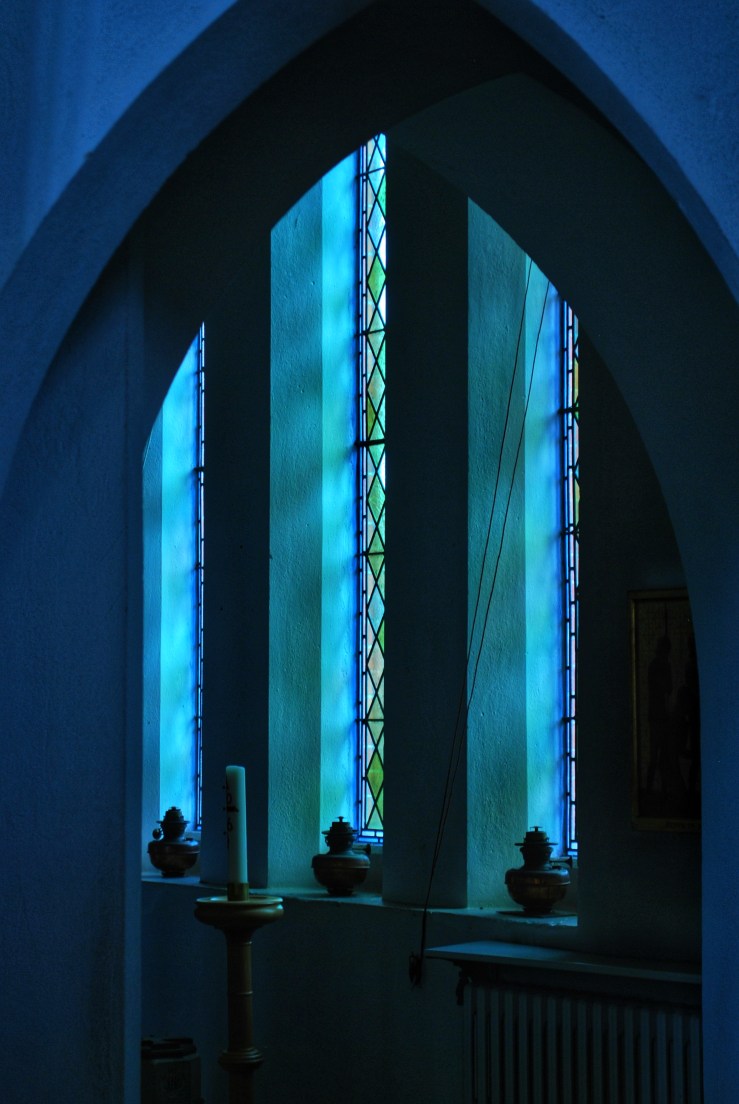
The seed of God is in us. Now the seed of a pear tree grows into a pear tree; and a hazel seed grows into a hazel tree; a seed of God grows into God. (Meister Eckhart)
Here, as stated before, it is my intention to draw from the forthcoming Sunday liturgy and to offer a guided prayer on one of the pieces of scripture in the same way that we have been doing in Exploring Personal Prayer. I do not intend to offer any reflections on the scripture. My suggestion is that you follow the Ignatian structure: preparation for prayer by reading the scripture, going to your prayer place and doing the prayer itself, and then moving away to another place and doing a review of the prayer. Keeping some sort of prayer journal is good practice. Note any moments of consolation in the prayer, where you felt drawn more deeply into God, and moments of desolation, where prayer was disturbed, where you were distracted and pulled further away from God: feelings of attraction and repulsion should be noted. These points may provide areas for repetition of the prayer. Also, if you have a spiritual director or prayer partner, someone who can listen with an ear to where God is in this, it may be worth sharing your prayer with them. I am following the processes outline in the prayer cards above. You may print these onto A6 or A4 card to have in your prayer space to help you become accustomed to this way of praying, remembering it is more of a flow than a rigid structure.
Rock Chapel at St. Beunos, North Wales.Praying with Images, Peter’s Declaration about Jesus: guided prayer
Peter’s Declaration about Jesus
13 Now when Jesus came into the district of Caesarea Philippi, he asked his disciples, ‘Who do people say that the Son of Man is?’ 14 And they said, ‘Some say John the Baptist, but others Elijah, and still others Jeremiah or one of the prophets.’ 15 He said to them, ‘But who do you say that I am?’ 16 Simon Peter answered, ‘You are the Messiah,[a] the Son of the living God.’ 17 And Jesus answered him, ‘Blessed are you, Simon son of Jonah! For flesh and blood has not revealed this to you, but my Father in heaven. 18 And I tell you, you are Peter,[b] and on this rock[c] I will build my church, and the gates of Hades will not prevail against it. 19 I will give you the keys of the kingdom of heaven, and whatever you bind on earth will be bound in heaven, and whatever you loose on earth will be loosed in heaven.’ 20 Then he sternly ordered the disciples not to tell anyone that he was[d] the Messiah.[e
Background music is the album: Keith Halligan – Lifestyle Meditation, Global Journey
I made my first eight day individually guided retreat in 2001 at Loyola Hall. I have been writing about my journey from that point in the Diary of a Sunflower. It was a lifetime ago, and I feel like a completely different person now compared to who I was then. My retreat this year, which was booked for next week at St. Beunos in North Wales, has been cancelled due to the pandemic, and this will be the first summer since that first retreat that I will not have gone away to spend eight days in silence with God, as I promised all those years ago. It would be easy to be upset about it, but to be honest, I was not surprised by the cancellation and I have accepted it. I am still going to do a retreat this week, at home, starting today, Sunday, and I have found a director who will meet with me online every day.
I have to say, doing spiritual direction online, both giving and receiving, has been one of the wonderful surprises of lockdown and I would never have imagined it to work as well as I have experienced it. So much so, that I am intending to expand into giving spiritual direction online as a matter of course from September, regardless of any lockdown situation or easing, so watch this space!
I have reservations about all the distractions at home of course, and since my daughters live with me, complete silence might be an issue. But, they are prepped and cooperative, and I can go into my room and shut my door. I have room to sit and be, and a prayer corner in there. I have prepared meals in the feezer, and my laundry done, and I have a garden. My computer will go in the drawer, and I will have my artboard on my desk instead.
Ditchingham Convent ChurchIGR 2020 2: Reading of this post.
While the nitty gritty of my preparations are probably uninteresting and do not really need to be shared, the point here is that I am creating a space – physical and psychological – to encounter God, to spend some time in deep with Him and away from all the distractions, and I am creating an environment that is conducive to that process. It is the principle described from the sixth to the ninth additions of the Spiritual Exercises:
I should not think of things that give pleasure and joy, as the glory of heaven, the Resurrection, etc., for if I wish to feel pain, sorrow, and tears for my sins, every consideration promoting joy and happiness will impede it. I should rather keep in mind that I want to be sorry and feel pain. Hence it would be better to call to mind death and judgment.
For the same reason I should deprive myself of all light, closing the shutters and doors when I am in my room, except when I need light to say prayers, to read, or to eat.
Ignatius gives these additions on the context of the First week, when we are contemplating sin and the grace we are asking for is sorrow and shame for our sins. The general idea is to make our enviroment conducive to our prayer.
So, here I am, I have finished my work for a bit and prepared my environment and my mind to spend this time alone with God in these unusual circumstances. I am up to date and taking a pause from my Journey with Julian of Norwich to be open to the process with the director. Am I concerned about distractions? about the world crowding in? Yes I am, and I am already prepared for how I might handle that. It comes in the form of a story in Anthony de Mello’s book, The Song of the Bird, called The Monk and the Woman:
Two Buddhist monks, on their way to the monastery, found an exceedingly beautiful woman at the riverbank. Like them, she wished to cross the river, but the water was too high. So one of the monks lifted her onto his back and carried her across.
His fellow monk was thoroughly scandalised. For two hours he berated him on his negligence on keeping the rule: Had he forgotten he was a monk? How did he dare touch a woman? And worse, carry her across the river? What would people say? Had he not brought their holy religion into disrepute? And so on.
The offending monk patiently listened to the never-ending sermon. Finally, he broke in with:
Brother, I dropped that woman at the river. Are you still carrying her?
Glennfinnan Viaduct, ScotlandIGR 2020 3: Reading of this post.
So, I will not be despondant that this is not the ideal situation in which to make my retreat: I will not listen to the desolating voices seeking to disrupt this time and I will not hold on to the noise around me, or the distractions, or any interruptions, if my daughters do not quite understand and ask me something, or if I have to answer the door. I am doing all that I can to be available to the One who loves me as if I were the only person in the whole world, and if it is enough for Him, it is enough for me. I am looking forward to it as much as I have any other retreat.
I will see you on the other side. There will be no Journey with Julian or Reflection next week, but the Prayer and the Diary entries are already scheduled, and I will be back to normal after next Sunday.
Here, as stated before, it is my intention to draw from the forthcoming Sunday liturgy and to offer a guided prayer on one of the pieces of scripture in the same way that we have been doing in Exploring Personal Prayer. I do not intend to offer any reflections on the scripture. My suggestion is that you follow the Ignatian structure: preparation for prayer by reading the scripture, going to your prayer place and doing the prayer itself, and then moving away to another place and doing a review of the prayer. Keeping some sort of prayer journal is good practice. Note any moments of consolation in the prayer, where you felt drawn more deeply into God, and moments of desolation, where prayer was disturbed, where you were distracted and pulled further away from God: feelings of attraction and repulsion should be noted. These points may provide areas for repetition of the prayer. Also, if you have a spiritual director or prayer partner, someone who can listen with an ear to where God is in this, it may be worth sharing your prayer with them. I am following the processes outline in the prayer cards above. You may print these onto A6 or A4 card to have in your prayer space to help you become accustomed to this way of praying, remembering it is more of a flow than a rigid structure.
I have chosen to leapfrog the Lectio Divina this week that I had originally intended to do because this particular gospel story is calling to me at this time, and I felt drawn to present this imaginative contemplation instead.
The Canaanite Woman’s Faith
Matthew 15:21-28
21 Jesus left that place and went away to the district of Tyre and Sidon. 22 Just then a Canaanite woman from that region came out and started shouting, ‘Have mercy on me, Lord, Son of David; my daughter is tormented by a demon.’ 23 But he did not answer her at all. And his disciples came and urged him, saying, ‘Send her away, for she keeps shouting after us.’ 24 He answered, ‘I was sent only to the lost sheep of the house of Israel.’ 25 But she came and knelt before him, saying, ‘Lord, help me.’ 26 He answered, ‘It is not fair to take the children’s food and throw it to the dogs.’ 27 She said, ‘Yes, Lord, yet even the dogs eat the crumbs that fall from their masters’ table.’ 28 Then Jesus answered her, ‘Woman, great is your faith! Let it be done for you as you wish.’ And her daughter was healed instantly
Imaginative contemplation: The Canaanite Woman’s faith. Guided prayer.
Background music is the album: Keith Halligan – Lifestyle Meditation, Global Journey
I have been thinking a lot about my dad recently. Perhaps it is because I have been writing about the aftermath of his death so many years ago in the Diary of a Sunflower, perhaps it is because I have been thinking and writing about Al Anon and the Twelve Steps, or perhaps it is because in the Journey with Julian of Norwich that I am praying with, the Mother God imagery is so prevalent, that it is also stimulating a dwelling on the image of Father God, and subsequently, thoughts of my own dad. It is probably all of these things that bring memories of him to the forefront of my mind. My eldest brother did the eulogy at the requiem mass for my dad and as he was preparing it, he asked each of us, my brothers and sisters, for a memory of my dad that was special to us. Mine was that my dad was always singing: he had an extensive knowledge of Scottish poetry and folk music, and he was always singing out loud. But he did not sing whole songs, just a couple of lines of many songs. So I have in my head the words to many Scottish songs, but not the whole song. It is a voyage of discovery when I hear a familiar tune, a few familiar lines, to then listen to the whole song. Here is an example, where the chorus and the first line were very familiar to me, but I had to find the full song, and even what it was called. This video clip has interjections from the excellent series “Outlander”, and other scenes from Scotland: although, the Outlander scenes are not about a woman losing her baby, or it being taken metaphorically by fairies, which is what the lullaby is about, based on Celtic mythology, I think. Outlander does have a scene in a later episode where a woman leaves her sickly child in the woods for the fairies to take, but that is a whole other story that is not really relevant here.
Thank you for the Music 2 : Reading of this post.
My children told me once that sometimes they would have a conversation about both parents, and the subject of one of those conversations was what quirky things they would miss if that particular parent died. They told me that they both agreed that what they would miss of me was that, sometimes when we were driving along playing music, a song would come on and I would turn it up and exclaim:
I love this song! This is about a conversation with God. Can’t you just imagine Him saying this to you?
Here is one of those songs, which expresses the joy and delight God takes in loving us, just as we are:
Thank you for the Music 3 : Reading of this post.
I have written before about how St. Ignatius encourages us to apply our senses to our imaginative contemplations, to use our memory, imagination and reason to help ground our experience in our bodies, to bring God more deeply into our reality. We call it the Application of the Senses, and it is a feature of repetition described in The Spiritual Exercises.
After the preparatory prayer and three preludes, it will be profitable with the aid of the imagination to apply the five senses to the subject matter of the First and Second Contemplation…
Since I have written about one of the senses explicitly before, it feels about time to dwell on another, and in particular, the aspect of hearing that is music. Like smelling fragrance, hearing music is very powerfully evocative and is also very much in the language God uses to speak to us. I am in complete agreement with Aldous Huxley here:
After silence, that which comes nearest to expressing the inexpressible is music.
Aldous Huxley
I remember clearly the imaginative contemplation where “Jamming with God” became a regular feature in my prayer. The director had suggested I pray with the part of the gospel where John the Baptist points out the Lamb of God to two of his followers:
The two disciples heard him say this, and they followed Jesus. 38 When Jesus turned and saw them following, he said to them, ‘What are you looking for?’ They said to him, ‘Rabbi’ (which translated means Teacher), ‘where are you staying?’ 39 He said to them, ‘Come and see.’ They came and saw where he was staying, and they remained with him that day’
When I went with Him to the place where He lived, we went to a house, constructed in a golden rectangle, with an arrangement of rooms as a golden spiral within that, and the Father and the Holy Spirit were there. This place appears often as the location of my colloquies in prayer, the conversation with God, as one friend speaks to another. Together, we spent the afternoon playing music, and there was also coffee and triple chocolate cake. But more of the latter another day, when I write about another of the senses. In my imagination, we played this following piece of music together:
Thank you for the Music 4 : Reading of this post.
In “The Fragrance of God“, I described the Father as the base note (Jasmine), Jesus as the middle note (Lavender) and the Holy Spirit as the top note (Ylang Ylang). I was talking about essential oils then, and I included myself as cedarwood, the combination making a single fragrance that is my relationship with, and my place in God, where nuances can be distinguished amidst the whole. So it is with music. In the piece by Sky, I imagine Jesus playing the piano – I have mentioned that I imagine Him playing piano before – and drums, The Father is on the bass, and the Holy Spirit is playing the acoustic and electric guitar. I am playing the melody on classical guitar, and it is my life, my soul, my story we are describing here. There are no words, the music is expressing it.
When I read Revelations of Divine Love by Julian of Norwich some years ago (rather than the present Journey I am doing), I developed an understanding of what I call “God time”. When she talked about the servant falling into the pit, in Revelations of Divine Love, she describes this as the Fall, not just the original Fall of our first parents in the garden of Eden, but also, simultaneously, the fall of Jesus into humanity, and so to bring about our redemption. I may of course, have oversimplified what Julian said, but what is significant in my understanding in what she said is that I realised that God was outside of time: to God, the past, present and the future are happening all at the same time. As the child planting sunflowers, seeing them grow was like watching time lapse photography, but instead of everything moving at speed, only the thing you were looking at moved, everything else stayed as it was – time only affecting what you are looking at is an aspect of God time.
It is like this also listening to music and jammimg with God. When I pick out something to listen to in the piece, a particular voice, I see that player, at that time. There can be more than one aspect of God playing simultaneously, but if I am listening to the drum part, I see Jesus playing drums. I may be aware of the piano playing, but when I switch my attention to the piano, I see Jesus playing piano. I can only be in the present, seeing and hearing the now, where I am, but God is not: God is everything and everywhere, all at the same time, and music is an expression of it.
Perhaps you could close your eyes and listen like this to the next piece of music? I imagine the Father on both the cello and the lute, and Jesus on the hapsichord. The Holy Spirit is on all of the violins. Pick out one voice at a time and focus on it, follow the flow of it, move to the next. Notice the movement within you.
Thank you for the Music 5 : Reading of this post.
To experience music is one way of applying our senses to allow our soul to hear the voice of God. My invitation to you is to notice exactly how it is that music connects you to God, both in prayer and in your life in general. And maybe, if it is relevant, to offer a grateful prayer.
Step 1 and The Spiritual Exercises 1: Reading of this post
I posted a while back on The Spiritual Exercises and The Twelve Steps and I notice that it is one of my most consistently read posts. I have been talking a lot about the steps recently with someone who is new to the program, and these two things are making me think more deeply yet about the steps myself, and about how they integrate with The Spiritual Exercises, and my with spirituality and how I find God in all things. I will say at this point that the opinions expressed here are my own and not representative of AA or Al Anon as a whole. The full first step is:
We admitted we were powerless over alcohol – that our lives had become unmanageable.
In Breathing Under Water, Richard Rohr draws a connection between addiction and sin, and makes four basic assumptions about addiction:
We are all addicts.
“Stinking Thinking” is the universal addiction – we are all addicted to our patterned way of thinking.
All societies are addicted to themselves and create a deep codependency on them.
Some form of alternative consciousness is the only freedom from this self and from cultural ties.
Redemption mandalaStep 1 and The Spiritual Exercises 2: Reading of this post
Some years ago I went to a talk given by Laurence Freeman organised by the Norwich Christian Meditation Centre, and his talk made a deep impression on me in lots of different ways. One part of it that stays with me was that he explained that the desert fathers saw sin as compulsions, and when I researched Dante’s nine circles of hell for the Redemption mandala that I was creating, I was taken by the fact that the first seven circles equated to the seven deadly sins. These stimuli gradually changed my thinking on sin from being a single event – something that I did, or failed to do – to a pattern of events, a path that I walked on that led me away from the one God lays down for me. In “The Me I want to Be”, John Ortberg talks about our signature sins. He says:
We do not get tempted by that which repulses us….It starts close to home with the passions and desires that God wired into us and tries to pull them a few degrees off course. That subtle deviation is enough to disrupt the flow of the Spirit in our life, so coming to recognise the pattern of sins most tempting to us is one of the most important steps in our spiritual life.
Put in this context, it might be easy to see how difficult it can be to notice that we are being pulled off course. We can be walking along steadily, in tune with God, and we come to a fork in the path. It might not be obvious immediately which fork is the one God is calling us to since the enemy is a deceiver, we do not always recognise him as the imposter. Ignatius himself warns us in the Spiritual Exercises:
It is characteristic of God and His Angels, when they act upon the soul, to give true happiness and spiritual joy, and to banish all the sadness and disturbances which are caused by the enemy.
It is characteristic of the evil one to fight against such happiness and consolation by proposing fallacious reasonings, subtilties, and continual deceptions.
It is a mark of the evil spirit to assume the appearance of an angel of light. He begins by suggesting thoughts that are suited to a devout soul, and ends by suggesting his own. For example, he will suggest holy and pious thoughts that are wholly in conformity with the sanctity of the soul. Afterwards, he will endeavor little by little to end by drawing the soul into his hidden snares and evil designs.
There is tell of Ignatius spending hours in the night contemplating a glorious vision instead of sleeping, night after night, before recognising that it was making him too tired the following day to carry out the work he knew God was calling him to. By noticing where it was leading, he was able to recognise it for the spiritual desolation that it was. The scene of his vision at the Cardoner river, as depicted in the film Ignacio de Loyola, moves me and strikes me as particularly relevant here, when Jesus says to Ignatius:
Do you think your sins would have any power over me had I not chosen it to be so?
“Discernment”; St. BeunosStep 1 and The Spiritual Exercises 3: Reading of this post
Distilling these thoughts down brings out the essence of “I am powerless”. Our strengths are also our weaknesses, and our weaknesses can be our strength. It is in noticing the movement within us, the discernment of where our thoughts, feelings and actions are coming from and where they are leading to, that is the admission of our powerlessness. St. Paul says:
I do not understand my own actions. For I do not do what I want, but I do the very thing I hate.
Here, in the cry of wonder, is the movement in the first of the twelve steps. In the twelve step program, we may be talking about alcohol, drugs, food, our codependency on an addict we love…fill in your own blank here. In the Exercises, we have already spent some time, deepening our relationship with the God who we already know loves us from the Principle and Foundation, and we have come to recognise our own pattern, our own signature sin. In the cry of wonder, we are admitting our powerlessness over it, and that in our being pulled along that particular path, it is getting in the way of our living fully, with God, and as the person He created us to be. The First step, like the First week, is about having the scales removed from our eyes and recognising it, and the effect it is having on our lives.
Bodwellian CastleStep 1 and The Spiritual Exercises 4: Reading of this post
I make it sound simple, but it is not. We stumble along blindly, not always or easily recognising the path we are walking on, or where it leads us, but thinking we are heading in the right direction. Have you ever been lost? You will know what I mean. There is always another fork in the path to lead us away. However, if we do happen to go down the wrong one, there is always another fork encouraging us back onto the path God would have us walk. Every temptation is another opportunity to choose God. The feeling of powerlessness can be in itself a source of fear, or lead to the abdication of responsibility. That might be spiritual desolation and is not the movement I am referring to here. The consolation of powerlessness allows us to let go of the perceived control we do not actually have; to recognise that these things around us are outwith our control and that we do not have to try to control them. We cannot prevent spiritual desolation: we cannot prevent the fork in the path, the temptation to follow our compulsions, our signature sin, and sometimes, we may well take the wrong path. It is who we are. The first step, the cry of wonder, allows us to put that hard headed will power down. We are not in control of it, we cannot manage it, and there is great consolation in admitting it and being able to put away our efforts to try to control something we have no power to control. It is a relief to let it go. To be in this place, to take the first step, to release the cry of wonder, opens a window and allows God’s light into that dark area in our soul. It is the beginnings of a wondrous transformation.
Here, as stated before, it is my intention to draw from the forthcoming Sunday liturgy and to offer a guided prayer on one of the pieces of scripture in the same way that we have been doing in Exploring Personal Prayer. I do not intend to offer any reflections on the scripture. My suggestion is that you follow the Ignatian structure: preparation for prayer by reading the scripture, going to your prayer place and doing the prayer itself, and then moving away to another place and doing a review of the prayer. Keeping some sort of prayer journal is good practice. Note any moments of consolation in the prayer, where you felt drawn more deeply into God, and moments of desolation, where prayer was disturbed, where you were distracted and pulled further away from God: feelings of attraction and repulsion should be noted. These points may provide areas for repetition of the prayer. Also, if you have a spiritual director or prayer partner, someone who can listen with an ear to where God is in this, it may be worth sharing your prayer with them. I am following the processes outline in the prayer cards above. You may print these onto A6 or A4 card to have in your prayer space to help you become accustomed to this way of praying, remembering it is more of a flow than a rigid structure.
13 Now when Jesus heard this, he withdrew from there in a boat to a deserted place by himself. But when the crowds heard it, they followed him on foot from the towns. 14 When he went ashore, he saw a great crowd; and he had compassion for them and cured their sick. 15 When it was evening, the disciples came to him and said, ‘This is a deserted place, and the hour is now late; send the crowds away so that they may go into the villages and buy food for themselves.’ 16 Jesus said to them, ‘They need not go away; you give them something to eat.’ 17 They replied, ‘We have nothing here but five loaves and two fish.’ 18 And he said, ‘Bring them here to me.’ 19 Then he ordered the crowds to sit down on the grass. Taking the five loaves and the two fish, he looked up to heaven, and blessed and broke the loaves, and gave them to the disciples, and the disciples gave them to the crowds. 20 And all ate and were filled; and they took up what was left over of the broken pieces, twelve baskets full. 21 And those who ate were about five thousand men, besides women and children.
Imaginative Contemplation: Feeding the Five Thousand. Guided prayer.
Background music is the album: Keith Halligan – Lifestyle Meditation, Global Journey
Here, as stated before, it is my intention to draw from the forthcoming Sunday liturgy and to offer a guided prayer on one of the pieces of scripture in the same way that we have been doing in Exploring Personal Prayer. I do not intend to offer any reflections on the scripture. My suggestion is that you follow the Ignatian structure: preparation for prayer by reading the scripture, going to your prayer place and doing the prayer itself, and then moving away to another place and doing a review of the prayer. Keeping some sort of prayer journal is good practice. Note any moments of consolation in the prayer, where you felt drawn more deeply into God, and moments of desolation, where prayer was disturbed, where you were distracted and pulled further away from God: feelings of attraction and repulsion should be noted. These points may provide areas for repetition of the prayer. Also, if you have a spiritual director or prayer partner, someone who can listen with an ear to where God is in this, it may be worth sharing your prayer with them. I am following the processes outline in the prayer cards above. You may print these onto A6 or A4 card to have in your prayer space to help you become accustomed to this way of praying, remembering it is more of a flow than a rigid structure.
Jesus Thanks His Father
25 At that time Jesus said, “I thank[a] you, Father, Lord of heaven and earth, because you have hidden these things from the wise and the intelligent and have revealed them to infants; 26 yes, Father, for such was your gracious will.[b]27 All things have been handed over to me by my Father; and no one knows the Son except the Father, and no one knows the Father except the Son and anyone to whom the Son chooses to reveal him.
28 “Come to me, all you that are weary and are carrying heavy burdens, and I will give you rest. 29 Take my yoke upon you, and learn from me; for I am gentle and humble in heart, and you will find rest for your souls. 30 For my yoke is easy, and my burden is light.”
Imaginative Contemplation: Matthew 11: 25-30. Guided prayer
Background music is the album: Keith Halligan – Lifestyle Meditation, Global Journey
Keith Duke, Christmas PoorWhen was it that we saw you? 1: Reading of this post
I have been pondering the line between self protection and self sacrifice this week. My dad was a generous man: it was said of him that he would give you the shirt off his back, that he was generous to a fault. He also had his own demons. These are traits that run in my family.
I brought my eldest home from the flat she was staying in this week because she had incurred the wrath of the residents who live in the flats around their communal, gated courtyard. She has a generous, loving and compassionate heart, a gift for ironic sarcasm, especially when she has had some Dutch courage, and she has more than enough of her own demons to fight. They did not like that she had invited a homeless person in through the gate to let him shower in her flat, while she washed his clothes and gave him some clean ones to wear. When he was challenged by one of the residents on leaving, he was impolite and they later rounded on my daughter like a pack of wolves. As I said, she has a gift for ironic sarcasm and did no more than add fuel to the blaze already burning.
In God of Surprises, Gerard W. Hughes writes an uncomplimentary reference for a Mr E. Manuel who has been applying for the priesthood. It it he says:
Three years ago he gave up his job and took to the road, returning occasionally with an unsavoury group of companions…a man can be judged by the friends he keeps.
This is the most perfect kind of humility. It consists in this. If we suppose the first and second kind attained, then whenever the praise and glory of the Divine Majesty would be equally served, in order to imitate and be in reality more like Christ our Lord, I desire and choose poverty with Christ poor, rather than riches; insults with Christ loaded with them, rather than honors; I desire to be accounted as worthless and a fool for Christ, rather than to be esteemed as wise and prudent in this world. So Christ was treated before me
Bodwellian CastleWhen was it that we saw you? 2: Reading of this post
In the Rules for Discernment, on the way the enemy works Ignatius also says:
The conduct of our enemy may also be compared to the tactics of a leader intent upon seizing and plundering a position he desires. A commander and leader of an army will encamp, explore the fortifications and defenses of the stronghold, and attack at the weakest point. In the same way, the enemy of our human nature investigates from every side all our virtues, theological, cardinal and moral. Where he finds the defenses of eternal salvation weakest and most deficient, there he attacks and tries to take us by storm.
And in “The Me I Want to Be”, John Ortberg comments that our signature sin is born from our greatest virtues, it is just pulled a few degrees off course. He says:
The pattern of your sin is related to the pattern of your gifts.
When was it that we saw you?3a: Reading of this post
These are the ideas swirling within me as I contemplate my daughter’s predicament, and her sensitivity to the hostility she has provoked by her actions and by her response to the hostility they provoked. It is not for me to tell her what she should do, or what she should have done. I can see where her castle wall was unprotected and I feel a deep sorrow and compassion for the suffering she experiences. I also see the grace in what moved her to act the way she did in the first place. She always shows empathy to the homeless person on the street and helps in whatever way she is able. She knows many of the homeless in the city by name, she looks them in the eye and speaks to them as friends, because she understands the saying:
There but for the grace of God go I.
Christ of MaryknollWhen was it that we saw you? 3b Reading of this post
There is a line between self protection and self sacrifice. I do not always know where to draw it for myself, I do not think my dad knew where to draw it either, and I believe it to be also true of my daughter. God inhabits that space. My daughter may be looking for a new place to live, and the homeless man? He apologised, and was gutted, that his impolite response to the resident who challenged him had rebounded on her. In addition, because he had been able to get cleaned up, he managed to get himself a job after leaving her flat. What else can I say, other than that I am proud of her?
How well have you loved?”
“Lord, why did you tell me to love?
I have tried, but I come back to you, frightened…
Lord, I was so peaceful at home, I was so comfortably settled.
Some years ago, I was standing in a queue to pay for some items in a shop and the man standing behind me started to chat in a friendly way, as sometimes people do. He looked a bit rough and ready, and I say that at the risk of sounding like a judgemental snob, but I chatted politely, as you do, to strangers in a shop queue. That is, until he started, explicitly, to spew out derogatory racial stereotypes about black people. I was shocked. I was so shocked that I froze like a rabbit in headlights, I am ashamed to say. I could not believe what I was hearing. I stood there with my mouth open and my chin on the floor, floundering like a fish, sweating and shifting uncomfortably until I was able to move away from him. And I was so angry with myself as I left the shop. I felt that I had really let down the friends that I had spent the previous evening with, who happened to be black. Big Boy Bloater and the Limits sum up what I wish I had said (except for the line about once thinking you were cool):
Black Lives Matter 2: Reading of this post.
It probably sounds naive, I know, I am cringing even as I remember it. I was a university student in the nineteen eighties, when the anti-apartheid sanctions were imposed on South Africa, and there was the campaign to free Nelson Mandela. Racism was being seriously challenged as a social issue. It was just not the done thing to express racist sentiments, or to even think them. The awareness and angst among my friends was that pehaps we were inherantly racist and that was why we did not have any black friends, or even know anyone who was black.
I am fortunate that in my days as a PhD student, I went to a conference held by the Catholic Student Council, and there was a young black woman there I became quite friendly with over the course of the week – amazing singer, she was leading the singing in the daily liturgies. I remember a conversation with her about all of this angst I was feeling, that I might be a closest racist because I did not have any friends that were black. She smiled gently and reassured me that it was probably because I had not had much opportunity socialise with people who were black, and that my awareness and angst about the possibility that I would be, made me less likely to discriminate against someone because of their race. She did not placate me, or deny that it was possible. For me, that is important because when our thoughts and actions are moving us away from God, Ignatius says that the good spirit:
…making use of the light of reason, he will rouse the sting of conscience and fill them with remorse.
and when the direction of our lives is towards God, he says:
It is characteristic of the good spirit, however, to give courage and strength, consolations, tears, inspirations, and peace. This He does by making all easy, by removing all obstacles so that the soul goes forward in doing good.
And I notice that I drew strength and encouragement from the conversation with that inspirational young woman.
I remember witnessing a similar, and very powerful, conversation in school. I ran an extra curricular discussion group for high achieving students and I invited my friend, one of the the ones I had been out with the evening prior to the unfortunate incident with the man in the shop queue. He had been involved in organising the events for Black History Month, and had spoken at the launch event. He sat there with these young students, and talked about racism, the Brixton riots in the eighties, folk devils…all manner of things, and they asked questions. They expressed the same fears that I had done, years before them, and asked him why, if the “n” word was so vile as they had been taught, then why did black singers use it in their music? And my friend educated them, and as he did, I saw them relax, to be less stressed, and to be able to ask everything they felt would be offensive to ask in a different context. Through my connection with him, a couple of those students were able to attend the Nelson Mandela 90th birthday concert – and they had an assignment on leadership to do for it, and others, specifically black students, had the opportunity to spend some time with black professionals in leadership positions in the local community, to raise the aspirations of these talented students beyond what they might think was possible for them.
Sign on the grass on The Pottergate in Norwich. No longer there.Black Lives Matter 3: Reading of this post.
I , like others, had some concern about the protests in the wake of the death of George Floyd, which are taking place in the time of the pandemic. Not because I disagree with the protests, I see the need for them. I once read a quote somewhere, but I am unable to find the exact quote, or who said it (not even on the internet!), which expressed the sentiment that protest was a valid means of expressing dissatisfaction when other means had been exhausted. Sikhism expresses something similar in terms of the sword, but it is not that I read.
My concern was that black and ethnic minority people are dis-proportionally affected by the coronavirus, whether those reasons are socioeconomic and/or genetic – I have not read of any clear evidence that it is only the former, the questions are being asked – and therefore, these mass protests were more risky than usual for the black and ethnic minorities taking part in them, and their families. I accept the point that that in itself, shows the strength of feeling, the importance of it, that it is a watershed moment. Then I read, and saw pictures, of the BLM protest in Eaton park in Norwich, where protesters went out in the rain, wearing face masks and bent the knee, maintaining the safe distance of the recommended two metres; similarly for the main protest at The Forum. I was, and I am still, deeply moved and I felt awe: yes, there it is, due respect for the disease that is killing people and care for our collective social responsibility to minimise that risk, together with the challenge to the structural, social and personal sin of racism. Taking the knee is a powerful statement.
I am also disgusted with, but not really surprised by, Dominic Raab’s unintelligent insensitivity this week when he said:
On this taking the knee thing, I don’t know, maybe it’s got a broader history, it seems to be taken from the Game of Thrones. It feels to me like a symbol of subjugation and subordination rather than one of liberation and emancipation, but I understand people feel differently about it so it’s a matter of personal choice.
Arrogant, proud, white privilege in action; denial and making light of the legitimate concerns of a large number of people, not just in the United Kingdom, but across the world. Catholic social teaching says on The Dignity of the Human Person:
12) The Catholic social vision has as its focal point the human person, the clearest reflection of God among us. Scripture tells us that every human being is made in the image of God. God became flesh when he entered the human race in the person of Jesus Christ, true God and true man. Christ challenges us to see his presence in our neighbour, especially the neighbour who suffers or who lacks what is essential to human flourishing. In relieving our neighbour’s suffering and meeting our neighbour’s needs, we are also serving Christ. For the Christian, therefore, there can be no higher privilege and duty.
13) We believe each person possesses a basic dignity that comes from God, not from any human quality or accomplishment, not from race or gender, age or economic status. The test therefore of every institution or policy is whether it enhances or threatens human dignity and indeed human life itself.
39) Catholic Social Teaching sees an intimate relationship between social and political liberation on the one hand, and on the other, the salvation to which the Church calls us in the name of Jesus Christ…
40)… requires the transformation of an unjust social order; and one of its primary tasks is to oppose and denounce such injustices.
And this same document suggests that it is Not an optional teaching:
41) All Catholic citizens need an informed “social conscience” that will enable them to identify and resist structures of injustice in their own society.
The Common Good statement from the Catholic Bishop’s Conference of England and Wales in 1996, urges us to challenge the structures of sin in our society. Racism exists: it exists in attitudes and structures. For white privilege to deny it is to display the planks of wood in our eyes. We are also guilty of the sins of our fathers if we refuse to acknowledge them, or if we minimise them with the “All lives matter” retort. Of course all lives matter, it is what has already been said. The reason it has to be stated explicitly that “Black Lives Matter” is because implicit racism in society implies that they do not, and it is disingenuous to nullify the emphasis with a trite response. The first step to healing is to listen, to acknowledge the truth in it, and to ask forgiveness and make amends. Dominic Raab may have thought that he was being witty and clever, but he displayed only arrogance and contempt.
Part of an Art Installation in London, on Wilberforce and the Abolition of Slavery in the UK.
William Wilberforce is a better role model. He listened and he learned; he showed constancy in challenging the slave act and tenacity, as he and his fellow campaigners sought to win hearts and minds in order that this evil could be abolished. So must we.
Black Lives Matter 5: Reading of this post.
On taking the knee? Yes, I will take the knee to express my solidarity and my respect for the Black Lives Matter movement and the campaign against racism. Is it an act of subjugation and subordination, as Raab says? Perhaps it is, but when that subjugation and subordination is to the One of whom St. Augustine says:
God loves each of us as if there were only one of us.
St. Augustine
I do not have an issue with it being so. I will end with Amazing Grace once more, as my prayer. And I’m going to watch this inspiring film again tonight, while I do my ironing.
You are the salt of the earth; but if salt has lost its taste, how can its saltiness be restored? It is no longer good for anything, but is thrown out and trampled under foot.
I have to be completely honest here and say, I have never really understood this part. I mean, I think I have an understanding of the point Jesus is making (on one level) but it seems like a poor analogy, and Jesus is not known for His poor analogies! I get stuck on the salt losing its taste. How can salt lose its taste? The statement contradicts itself, surely? If it no longer tastes like salt, then it no longer is salt. I am of course thinking from a Chemistry perspective. It is the ions that make the salt taste salty, and sodium chloride, salt, is chemically very stable, resistant to change. It requires the use of electricity in electrolysis to convert the sodium and chloride ions back into elements and so, destroy the saltiness, or the salt. I do not really think this is what Jesus was getting at!
So, I started to ponder salt. Quite an ordinary substance, and useful. Firstly, when you put it in boiling water for cooking, it raises the boiling temperature of the water (boiling point elevation) and so will help to cook the food more quickly. The sodium ions also insert themselves in between chains of pectin in vegetables – pectin is partly what gives raw vegetables their hardness – and so helps to soften them in the boiling cooking water. It also enhances the taste of food – it is not so much its own salty taste, but the augmented taste of the food we are after when we season it with salt. And of course, it is used as a preservative, to stop food from going off too quickly. From here, I could apply the analogy to the disciples to whom Jesus was speaking: their role, (and our role) to soften the hardness of heart in those we meet, to encourage that process by interjecting where the love of God is needed; to help to draw out God in each person we meet, to enhance their own goodness by our interaction with them; and to be a preservative, to act to slow down the movement away from God, to act against the desolation that seeks to spoil those gifts given so generously by God.
It is said that the graces received in the Exercises are always there, they are never lost, and I would testify to that from my first hand experience. I am still stuck…how can salt lose its taste? So, I consulted Wikipedia:
The most common interpretation of this verse is a reference to salt as a preservative, and to thus see the duty of the disciples as preserving the purity of the world.
…salt was a minor but essential ingredient in fertilizer,…the disciples are thus to help the world grow and prosper…indicating that the disciples are to bring new life to the world
…a common Jewish expression at the time was to call the Laws the “salt and the light” of the world, which may mean this section is an introduction to the discussion of Mosaic law that will soon commence.
In the Rabbinic literature of the period salt was a metaphor for wisdom.
Salt also played role in ritual purity and all sacrifices had to contain salt.
…the many different uses of salt show its importance in the life of the period, and it is this importance of the disciples that is being referenced.
Ancient peoples sometimes put salt on the wicks of lamps to increase their brightness.
I learned a lot here, all good stuff, although I am not clear how putting salt on the wicks of lamps can increase their brightness. I feel a home experiment coming on. I also felt vindicated at the beginning of the section on Losing Saltiness:
The issue of salt losing its flavour is somewhat problematic. Salt itself, sodium chloride (NaCl), is extremely stable and cannot lose its flavour.
It goes on to make the point that Jesus was not teaching Chemistry, and considers:
…the impossibility of what is described as deliberate, it is counter to nature that salt lose its flavour, just as it is counter to God’s will that the disciples lose faith.
There it is! Not only does Jesus know Chemistry: you must know already that I love Chemistry, He uses it to say:
You will always be mine. Nothing can ever take you away from me.
How cool is that? I am just going to pause for a moment and savour the flavour of this realisation.
It is the same promise He made to the young woman in His workshop that I described in my post last week.
Wikipedia then goes on to talk about impurities, and as I suggested at the beginning, these impurities are not salt, and therefore do not taste like salt. Perhaps it would be to extend the analogy to describe spiritual desolation, and I would point out that dissolution, filtration and recrystallisation will extract and purify salt which has been so “corrupted”. The eleven year olds in my science class know how to do that. So too then, might the impurities in our own hearts be cleansed with water, separated from that which would draw us away from God, and purified by prayer and time spent with Him until we are indeed salt of the earth in the way that Jesus intends us to be. We are in essence, not lost to Him and always retrievable by Him.
…the warmth of the light draws us gently out of the darkness, it invites us not to remain there.
I was at that time referring to our response to God’s light, but here, it also applies when considering how the followers of Jesus might be attractive to others. In the meditation of the two standards Ignatius says:
Consider the address which Christ our Lord makes to all His servants and friends whom He sends on this enterprise, recommending to them to seek to help all, first by attracting them to the highest spiritual poverty,
And in the Contemplation to Attain the Love of God, which means to become able to love like God loves, not to win God’s love as it might be misunderstood, Ignatius makes two points:
The first is that love ought to manifest itself in deeds rather than in words.
The second is that love consists in a mutual sharing of goods, for example, the lover gives and shares with the beloved what he possesses, or something of that which he has or is able to give; and vice versa, the beloved shares with the lover. Hence, if one has knowledge, he shares it with the one who does not possess it; and so also if one has honors, or riches. Thus, one always gives to the other.
This is to consider how God works and labors for me in all creatures upon the face of the earth, that is, He conducts Himself as one who labors. Thus, in the heavens, the elements, the plants, the fruits, the cattle, etc., He gives being, conserves them, confers life and sensation, etc.
If God shines His light on the world as described previously, it is for us to do likewise, to attract and draw others to the source that is light itself. Salt and light. It is not enough to keep it all to ourselves.