IGR 2020

IGR 2020 1: Reading of this post.

I made my first eight day individually guided retreat in 2001 at Loyola Hall. I have been writing about my journey from that point in the Diary of a Sunflower. It was a lifetime ago, and I feel like a completely different person now compared to who I was then. My retreat this year, which was booked for next week at St. Beunos in North Wales, has been cancelled due to the pandemic, and this will be the first summer since that first retreat that I will not have gone away to spend eight days in silence with God, as I promised all those years ago. It would be easy to be upset about it, but to be honest, I was not surprised by the cancellation and I have accepted it. I am still going to do a retreat this week, at home, starting today, Sunday, and I have found a director who will meet with me online every day.

I have to say, doing spiritual direction online, both giving and receiving, has been one of the wonderful surprises of lockdown and I would never have imagined it to work as well as I have experienced it. So much so, that I am intending to expand into giving spiritual direction online as a matter of course from September, regardless of any lockdown situation or easing, so watch this space!

I have reservations about all the distractions at home of course, and since my daughters live with me, complete silence might be an issue. But, they are prepped and cooperative, and I can go into my room and shut my door. I have room to sit and be, and a prayer corner in there. I have prepared meals in the feezer, and my laundry done, and I have a garden. My computer will go in the drawer, and I will have my artboard on my desk instead.
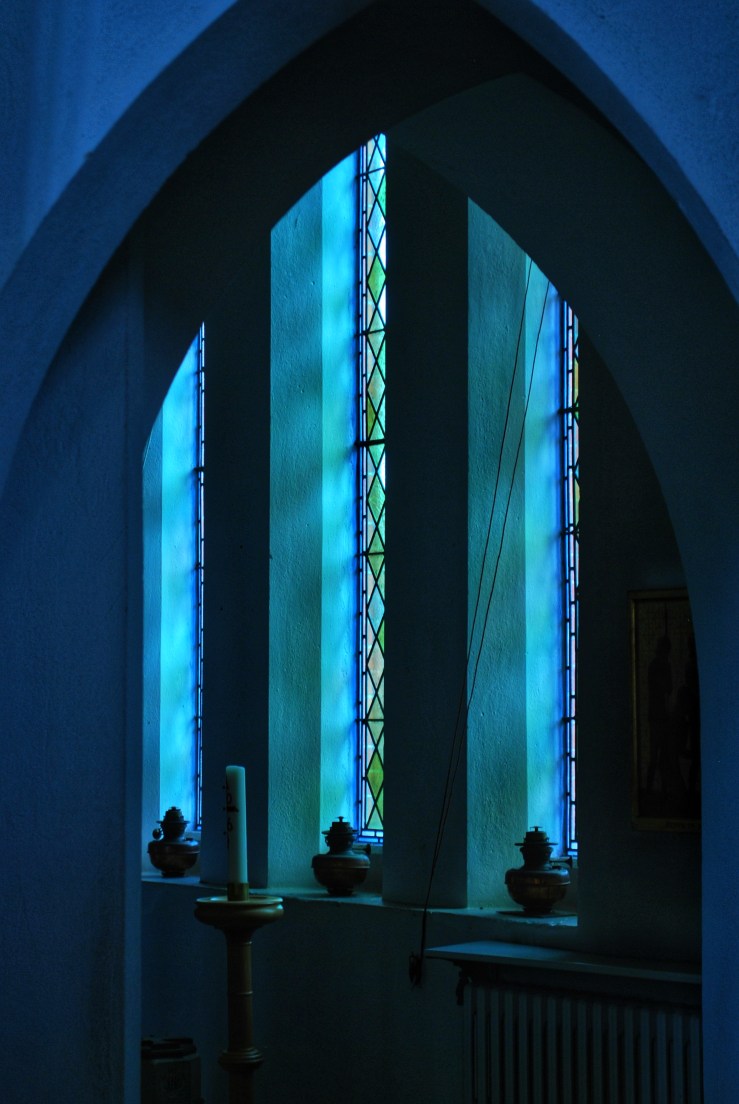
Ditchingham Convent Church
IGR 2020 2: Reading of this post.

While the nitty gritty of my preparations are probably uninteresting and do not really need to be shared, the point here is that I am creating a space – physical and psychological – to encounter God, to spend some time in deep with Him and away from all the distractions, and I am creating an environment that is conducive to that process. It is the principle described from the sixth to the ninth additions of the Spiritual Exercises:

I should not think of things that give pleasure and joy, as the glory of heaven, the Resurrection, etc., for if I wish to feel pain, sorrow, and tears for my sins, every consideration promoting joy and happiness will impede it. I should rather keep in mind that I want to be sorry and feel pain. Hence it would be better to call to mind death and judgment.

The Spiritual Exercise of St. Ignatius of Loyola, trans Louis J Puhl

For the same reason I should deprive myself of all light, closing the shutters and doors when I am in my room, except when I need light to say prayers, to read, or to eat.

The Spiritual Exercise of St. Ignatius of Loyola, trans Louis J Puhl

I should not laugh or say anything that would cause laughter.

The Spiritual Exercise of St. Ignatius of Loyola, trans Louis J Puhl

I should restrain my eyes except to look up in receiving or dismissing one with whom I have to speak.

The Spiritual Exercise of St. Ignatius of Loyola, trans Louis J Puhl

Ignatius gives these additions on the context of the First week, when we are contemplating sin and the grace we are asking for is sorrow and shame for our sins. The general idea is to make our enviroment conducive to our prayer.

So, here I am, I have finished my work for a bit and prepared my environment and my mind to spend this time alone with God in these unusual circumstances. I am up to date and taking a pause from my Journey with Julian of Norwich to be open to the process with the director. Am I concerned about distractions? about the world crowding in? Yes I am, and I am already prepared for how I might handle that. It comes in the form of a story in Anthony de Mello’s book, The Song of the Bird, called The Monk and the Woman:

Two Buddhist monks, on their way to the monastery, found an exceedingly beautiful woman at the riverbank. Like them, she wished to cross the river, but the water was too high. So one of the monks lifted her onto his back and carried her across.

His fellow monk was thoroughly scandalised. For two hours he berated him on his negligence on keeping the rule: Had he forgotten he was a monk? How did he dare touch a woman? And worse, carry her across the river? What would people say? Had he not brought their holy religion into disrepute? And so on.

The offending monk patiently listened to the never-ending sermon. Finally, he broke in with:

Brother, I dropped that woman at the river. Are you still carrying her?

Glennfinnan Viaduct, Scotland
IGR 2020 3: Reading of this post.

So, I will not be despondant that this is not the ideal situation in which to make my retreat: I will not listen to the desolating voices seeking to disrupt this time and I will not hold on to the noise around me, or the distractions, or any interruptions, if my daughters do not quite understand and ask me something, or if I have to answer the door. I am doing all that I can to be available to the One who loves me as if I were the only person in the whole world, and if it is enough for Him, it is enough for me. I am looking forward to it as much as I have any other retreat.

I will see you on the other side. There will be no Journey with Julian or Reflection next week, but the Prayer and the Diary entries are already scheduled, and I will be back to normal after next Sunday.

Thank you for the Music

Thank you for the Music 1 : Reading of this post.

I have been thinking a lot about my dad recently. Perhaps it is because I have been writing about the aftermath of his death so many years ago in the Diary of a Sunflower, perhaps it is because I have been thinking and writing about Al Anon and the Twelve Steps, or perhaps it is because in the Journey with Julian of Norwich that I am praying with, the Mother God imagery is so prevalent, that it is also stimulating a dwelling on the image of Father God, and subsequently, thoughts of my own dad. It is probably all of these things that bring memories of him to the forefront of my mind. My eldest brother did the eulogy at the requiem mass for my dad and as he was preparing it, he asked each of us, my brothers and sisters, for a memory of my dad that was special to us. Mine was that my dad was always singing: he had an extensive knowledge of Scottish poetry and folk music, and he was always singing out loud. But he did not sing whole songs, just a couple of lines of many songs. So I have in my head the words to many Scottish songs, but not the whole song. It is a voyage of discovery when I hear a familiar tune, a few familiar lines, to then listen to the whole song. Here is an example, where the chorus and the first line were very familiar to me, but I had to find the full song, and even what it was called. This video clip has interjections from the excellent series “Outlander”, and other scenes from Scotland: although, the Outlander scenes are not about a woman losing her baby, or it being taken metaphorically by fairies, which is what the lullaby is about, based on Celtic mythology, I think. Outlander does have a scene in a later episode where a woman leaves her sickly child in the woods for the fairies to take, but that is a whole other story that is not really relevant here.

Thank you for the Music 2 : Reading of this post.

My children told me once that sometimes they would have a conversation about both parents, and the subject of one of those conversations was what quirky things they would miss if that particular parent died. They told me that they both agreed that what they would miss of me was that, sometimes when we were driving along playing music, a song would come on and I would turn it up and exclaim:

I love this song! This is about a conversation with God. Can’t you just imagine Him saying this to you?

Here is one of those songs, which expresses the joy and delight God takes in loving us, just as we are:

Thank you for the Music 3 : Reading of this post.

I have written before about how St. Ignatius encourages us to apply our senses to our imaginative contemplations, to use our memory, imagination and reason to help ground our experience in our bodies, to bring God more deeply into our reality. We call it the Application of the Senses, and it is a feature of repetition described in The Spiritual Exercises.

After the preparatory prayer and three preludes, it will be profitable with the aid of the imagination to apply the five senses to the subject matter of the First and Second Contemplation…

The Spiritual Exercises of St. Ignatius trans. Louis J. Puhl S.J.

Since I have written about one of the senses explicitly before, it feels about time to dwell on another, and in particular, the aspect of hearing that is music. Like smelling fragrance, hearing music is very powerfully evocative and is also very much in the language God uses to speak to us. I am in complete agreement with Aldous Huxley here:

After silence, that which comes nearest to expressing the inexpressible is music.

Aldous Huxley

I remember clearly the imaginative contemplation where “Jamming with God” became a regular feature in my prayer. The director had suggested I pray with the part of the gospel where John the Baptist points out the Lamb of God to two of his followers:

The two disciples heard him say this, and they followed Jesus. 38 When Jesus turned and saw them following, he said to them, ‘What are you looking for?’ They said to him, ‘Rabbi’ (which translated means Teacher), ‘where are you staying?’ 39 He said to them, ‘Come and see.’ They came and saw where he was staying, and they remained with him that day’

John 1: 37-39a

When I went with Him to the place where He lived, we went to a house, constructed in a golden rectangle, with an arrangement of rooms as a golden spiral within that, and the Father and the Holy Spirit were there. This place appears often as the location of my colloquies in prayer, the conversation with God, as one friend speaks to another. Together, we spent the afternoon playing music, and there was also coffee and triple chocolate cake. But more of the latter another day, when I write about another of the senses. In my imagination, we played this following piece of music together:

Thank you for the Music 4 : Reading of this post.

In “The Fragrance of God“, I described the Father as the base note (Jasmine), Jesus as the middle note (Lavender) and the Holy Spirit as the top note (Ylang Ylang). I was talking about essential oils then, and I included myself as cedarwood, the combination making a single fragrance that is my relationship with, and my place in God, where nuances can be distinguished amidst the whole. So it is with music. In the piece by Sky, I imagine Jesus playing the piano – I have mentioned that I imagine Him playing piano before – and drums, The Father is on the bass, and the Holy Spirit is playing the acoustic and electric guitar. I am playing the melody on classical guitar, and it is my life, my soul, my story we are describing here. There are no words, the music is expressing it.

When I read Revelations of Divine Love by Julian of Norwich some years ago (rather than the present Journey I am doing), I developed an understanding of what I call “God time”. When she talked about the servant falling into the pit, in Revelations of Divine Love, she describes this as the Fall, not just the original Fall of our first parents in the garden of Eden, but also, simultaneously, the fall of Jesus into humanity, and so to bring about our redemption. I may of course, have oversimplified what Julian said, but what is significant in my understanding in what she said is that I realised that God was outside of time: to God, the past, present and the future are happening all at the same time. As the child planting sunflowers, seeing them grow was like watching time lapse photography, but instead of everything moving at speed, only the thing you were looking at moved, everything else stayed as it was – time only affecting what you are looking at is an aspect of God time.

It is like this also listening to music and jammimg with God. When I pick out something to listen to in the piece, a particular voice, I see that player, at that time. There can be more than one aspect of God playing simultaneously, but if I am listening to the drum part, I see Jesus playing drums. I may be aware of the piano playing, but when I switch my attention to the piano, I see Jesus playing piano. I can only be in the present, seeing and hearing the now, where I am, but God is not: God is everything and everywhere, all at the same time, and music is an expression of it.

Perhaps you could close your eyes and listen like this to the next piece of music? I imagine the Father on both the cello and the lute, and Jesus on the hapsichord. The Holy Spirit is on all of the violins. Pick out one voice at a time and focus on it, follow the flow of it, move to the next. Notice the movement within you.

Thank you for the Music 5 : Reading of this post.

To experience music is one way of applying our senses to allow our soul to hear the voice of God. My invitation to you is to notice exactly how it is that music connects you to God, both in prayer and in your life in general. And maybe, if it is relevant, to offer a grateful prayer.

Admitted we were powerless: Step 1 and the Spiritual Exercises

Step 1 and The Spiritual Exercises 1: Reading of this post

I posted a while back on The Spiritual Exercises and The Twelve Steps and I notice that it is one of my most consistently read posts. I have been talking a lot about the steps recently with someone who is new to the program, and these two things are making me think more deeply yet about the steps myself, and about how they integrate with The Spiritual Exercises, and my with spirituality and how I find God in all things. I will say at this point that the opinions expressed here are my own and not representative of AA or Al Anon as a whole. The full first step is:

We admitted we were powerless over alcohol – that our lives had become unmanageable.

https://www.alcoholics-anonymous.org.uk/About-AA/The-12-Steps-of-AA

In Breathing Under Water, Richard Rohr draws a connection between addiction and sin, and makes four basic assumptions about addiction:

  1. We are all addicts.
  2. “Stinking Thinking” is the universal addiction – we are all addicted to our patterned way of thinking.
  3. All societies are addicted to themselves and create a deep codependency on them.
  4. Some form of alternative consciousness is the only freedom from this self and from cultural ties.
Redemption mandala
Step 1 and The Spiritual Exercises 2: Reading of this post

Some years ago I went to a talk given by Laurence Freeman organised by the Norwich Christian Meditation Centre, and his talk made a deep impression on me in lots of different ways. One part of it that stays with me was that he explained that the desert fathers saw sin as compulsions, and when I researched Dante’s nine circles of hell for the Redemption mandala that I was creating, I was taken by the fact that the first seven circles equated to the seven deadly sins. These stimuli gradually changed my thinking on sin from being a single event – something that I did, or failed to do – to a pattern of events, a path that I walked on that led me away from the one God lays down for me. In “The Me I want to Be”, John Ortberg talks about our signature sins. He says:

We do not get tempted by that which repulses us….It starts close to home with the passions and desires that God wired into us and tries to pull them a few degrees off course. That subtle deviation is enough to disrupt the flow of the Spirit in our life, so coming to recognise the pattern of sins most tempting to us is one of the most important steps in our spiritual life.

The Me I Want to Be. John Ortberg

and further:

Our sin takes a consistent and predictable course….the pattern of your sin is related to the pattern of your gifts.

The Me I Want to Be. John Ortberg

Put in this context, it might be easy to see how difficult it can be to notice that we are being pulled off course. We can be walking along steadily, in tune with God, and we come to a fork in the path. It might not be obvious immediately which fork is the one God is calling us to since the enemy is a deceiver, we do not always recognise him as the imposter. Ignatius himself warns us in the Spiritual Exercises:

It is characteristic of God and His Angels, when they act upon the soul, to give true happiness and spiritual joy, and to banish all the sadness and disturbances which are caused by the enemy.

It is characteristic of the evil one to fight against such happiness and consolation by proposing fallacious reasonings, subtilties, and continual deceptions.

The Spiritual Exercises of St. Ignatius trans. Louis J Puhl

It is a mark of the evil spirit to assume the appearance of an angel of light. He begins by suggesting thoughts that are suited to a devout soul, and ends by suggesting his own. For example, he will suggest holy and pious thoughts that are wholly in conformity with the sanctity of the soul. Afterwards, he will endeavor little by little to end by drawing the soul into his hidden snares and evil designs.

The Spiritual Exercises of St. Ignatius trans. Louis J Puhl

There is tell of Ignatius spending hours in the night contemplating a glorious vision instead of sleeping, night after night, before recognising that it was making him too tired the following day to carry out the work he knew God was calling him to. By noticing where it was leading, he was able to recognise it for the spiritual desolation that it was. The scene of his vision at the Cardoner river, as depicted in the film Ignacio de Loyola, moves me and strikes me as particularly relevant here, when Jesus says to Ignatius:

Do you think your sins would have any power over me had I not chosen it to be so?

“Discernment”; St. Beunos
Step 1 and The Spiritual Exercises 3: Reading of this post

Distilling these thoughts down brings out the essence of “I am powerless”. Our strengths are also our weaknesses, and our weaknesses can be our strength. It is in noticing the movement within us, the discernment of where our thoughts, feelings and actions are coming from and where they are leading to, that is the admission of our powerlessness. St. Paul says:

I do not understand my own actions. For I do not do what I want, but I do the very thing I hate.

Romans 7:15

In the second exercise of the first week of The Spiritual Exercises, we spend time meditating on our own sins. The desire we ask for is:

…a growing and intense sorrow and tears for my sins.

The Spiritual Exercises of St. Ignatius trans. Louis J Puhl

and the movement leads to:

a cry of wonder…How is it that the earth did not open to swallow me up, and create new hells in which I should be tormented forever!

The Spiritual Exercises of St. Ignatius trans. Louis J Puhl

Here, in the cry of wonder, is the movement in the first of the twelve steps. In the twelve step program, we may be talking about alcohol, drugs, food, our codependency on an addict we love…fill in your own blank here. In the Exercises, we have already spent some time, deepening our relationship with the God who we already know loves us from the Principle and Foundation, and we have come to recognise our own pattern, our own signature sin. In the cry of wonder, we are admitting our powerlessness over it, and that in our being pulled along that particular path, it is getting in the way of our living fully, with God, and as the person He created us to be. The First step, like the First week, is about having the scales removed from our eyes and recognising it, and the effect it is having on our lives.

Bodwellian Castle
Step 1 and The Spiritual Exercises 4: Reading of this post

I make it sound simple, but it is not. We stumble along blindly, not always or easily recognising the path we are walking on, or where it leads us, but thinking we are heading in the right direction. Have you ever been lost? You will know what I mean. There is always another fork in the path to lead us away. However, if we do happen to go down the wrong one, there is always another fork encouraging us back onto the path God would have us walk. Every temptation is another opportunity to choose God. The feeling of powerlessness can be in itself a source of fear, or lead to the abdication of responsibility. That might be spiritual desolation and is not the movement I am referring to here. The consolation of powerlessness allows us to let go of the perceived control we do not actually have; to recognise that these things around us are outwith our control and that we do not have to try to control them. We cannot prevent spiritual desolation: we cannot prevent the fork in the path, the temptation to follow our compulsions, our signature sin, and sometimes, we may well take the wrong path. It is who we are. The first step, the cry of wonder, allows us to put that hard headed will power down. We are not in control of it, we cannot manage it, and there is great consolation in admitting it and being able to put away our efforts to try to control something we have no power to control. It is a relief to let it go. To be in this place, to take the first step, to release the cry of wonder, opens a window and allows God’s light into that dark area in our soul. It is the beginnings of a wondrous transformation.

On Being in the Cave

On being in the Cave 1: Reading of this post.

I read the book “Quarantine” by Jim Crace for the second time at the beginning of lockdown. You may remember that lockdown began during Lent, and this book is a story about what happened when Jesus went into the desert to spend His forty days and forty nights, and faced His temptations. It seemed an appropriate read for that time and that situation.

Some years ago I spent some time working with “A Way in the Wilderness”, the first Chapter of the Spirituality Workbook by David Runcorn. He says:

In the desert, driven by the Spirit, we too will enter into tough battles with our allegiences and priorities, our passions and longings and the discerning of evil.

Spirituality Workbook, David Runcorn

And he talks about waiting:

Nothing happens fast in the heat of the desert. There is a different understanding of time and it involves a lot of waiting. A world addicted to ever faster ways of doing things finds such a place deeply frustrating – a waste of time in fact.

Spirituality Workbook, David Runcorn

I do not like being too hot – I have a very low threshold for even the temperatures we call a heatwave in the United Kingdom, so please believe me when I say that I am not at all attracted to the desert and do not want to spend any time there if I can avoid it. What struck me about Quarantine though, was that the pilgrims sought out caves to spend their time of the desert in, and I had never thought of that on a conscious level before, although rationally, it makes sense. Perhaps it is because one of the first films I ever saw at the cinema as a child was “Lost in the Desert”, and the young boy who was lost, spent most of his time in the open desert, as far as I can remember. This film made a long lasting impression on me. So, while the image of the desert is prevalent as an image of the spiritual journey, the image of the cave, although it is around, is less commonly talked about in my experience.

On Being in the Cave 2: Reading of this post.

It is the cave that is capturing my imagination at the moment, partly because we have been in lockdown, or quarantine recently, and partly because of the Mother God imagery that has been coming up in my journey with Julian of Norwich. Let me explain the connection: some years ago, I did an imaginative contemplation with the Healing of Jarius’ daughter. In that prayer, I was the young girl who was sick and dying. In the part of the prayer where, in the outside world, the girl had died, I lay down in my imagination in what was a tomb, a sealed up cave, which had a stone shelf carved into the wall. As I lay there, drifting off to sleep, I became aware that the walls of the cave were warm, and living. I was no longer in a cave, but in a womb. Hence my linking of Mother God and the image of the cave.

So what do these two images have in common that I would put them together in this way? One of the essentials David Runcorn suggests for desert spirituality is stability, and he says:

Stay in your cell and your cell will teach you everything.

Spirituality Workbook, David Runcorn

and in “Quarantine”, and indeed with the Desert Fathers of the church, the Cave equated to the Cell, it was a stable place, a place of shelter from predators and the heat of the day and the cold of the night: a place of safety, of seclusion, isolated from the world and its relentless distractions. The same might be said of the womb.

In “If You Want to Walk on Water, You’ve Got to Get Out of the Boat”, John Ortberg describes the cave as a place of transformation, of growth. Here, hidden away from the world, in a place of relative safety, we undergo changes in our being and we become different, emerging at the end of our quarantine to face the world afresh, where things will never be the same again. It is certainly true of the characters in Jim Crace’s book, including Jesus. And of course, in the womb, changes take place from the implantation of the fertilised egg, to the embryo, foetus and full term baby to emerge at birth. Both the time in the desert caves and gestation are periods where nothing happens fast: it feels slow, and little evidence of change might be seen, but nevertheless, the changes taking place are deep and lasting. There is no going back to how it was before.

But the cave and the womb are also not the same: the cave is a hard, difficult place and dangers may have to be faced in claiming it as your space – wild animals for example, as well as the spiritual battle which ensues. St. Ignatius wrote the Spiritual Exercises while living in the cave at Manresa, and there was a cost to it, a great turmoil of spirits and struggle with spiritual desolation. The film, Ignacio de Loyola, depicts this struggle in a gruesome, physical way and is not a watch for the faint hearted.

On Being in the Cave 3: Reading of this post.

Within the novel, for one of the characters, the cave is not respected and she is violated within that space. Jesus Himself might have experienced intrusion from the “devil” of the piece, had He not chosen a cave that was in the extreme of difficult and dangerous to get to. Even then, it did not stop the harassment. The cave, as St. Ignatius experienced, is a place conflict and struggle with evil, as David Runcorn says in his book. The womb on the other hand, is warm and living, and life giving: a place of just being – who can remember their time in the womb? – and of being in another who is greater and more powerful than myself. It is a place of safety and protection like the cave, but unlike the cave, it is nurturing rather than challenging, at least until the term of the pregnancy. When the time comes, the pressure forces the birth, the emergence from the womb in what at times, is a difficult and traumatic experience for the one being born, as monitors of a baby’s heart rate during labour will testify.

Cave at Mellieha, Malta
On Being in the Cave 4: Reading of this post.

It is the emergence from quarantine that is playing on my mind. In the relative safety of lockdown, I have changed and grown. There is a profound recognition of what I was becoming aware of before, and there is a rising pressure for a change, but it is for a change who’s time has not yet come. There is a sense of being thrust into the world again, before I am quite ready, a premature birth if you like. My rational brain, on being back in school last week, is supportive of the measures my school is taking to reduce the risk of transmission of coronavirus and have a full return to school in September – it is what staff were preparing the physical environment for last week. My reptile brain is not happy; my reptile brain is so unhappy that it is telling me to run away as fast as I can. And true to the discernment process, I need to sit with God and allow His light to shine upon this anxious fear that is presenting itself. On the one hand, the threat is real. The virus has not been eliminated, and so many people in close contact increases the risk of further transmission. It is not unreasonable to be cautious, and that fear at the level of an uncomfortable reptile brain is a valid response to the situation which will foster respect and attention to due protocols, for the safety of everyone. What may or may not be the other hand are the changes that need to be made to the day to day working procedures – teachers moving between classes with our own trolleys, rather than the students for example. What bothers me the most though, is that I will not be able to sit down next to a student when they are stuck, to give them those minutes of close, one to one or small group attention, that will make all the difference to their learning and to their wellbeing. How do I do that with social distancing? When I think about returning to the classroom, it is this thought that is plaguing me. It is this type of interaction that is the most valuable, not that it is the only one, and I am pondering strategies to achieve it within the context of social distancing.

On being out and about, there is a strange mix of more like it used to be, and not quite how it used to be. It does not feel like a new normal. It feels a bit like stumbling blindly out of the darkness, and our eyes have not yet adjusted to the light. Perhaps we are emerging too soon, too quickly. Like childbirth, the pressure is compelling us out and there is no resisting it. Perhaps our cave has become our womb, and is too comfortable; that we have grown so much that it is time and only the discomfort that will force us out to live in the world as required, rather than hide away safe. Perhaps we are rushing out of our caves, ready to take on the world because it is time, and we learned what was needed; perhaps we are rushing out of our caves because the darkness, loneliness and difficulty of it were too much for us to bear and to breathe in the daylight and feel the sun on our skin is a relief, in spite of the invisible dangers.

St. Mary’s Church, Startson.
On being in the Cave 5: Reading of this post.

In “Quarantine” there was a sense of it being the right time when the pilgrims emerged from their caves and made their way back to the world renewed: there was a sense of it being done. I do not feel that way quite yet. I am looking out of my cave with a little trepidation, sticking my toe out to see what will happen, and then maybe standing just outside the mouth of my cave for a short time. I am grateful for the school summer holidays, which have given me more time to prepare, more time to emerge slowly and to be ready to leave. In the meantime, I am enjoying this refuge, this space and time and the challenges it presents. God is with me in this place, working with me, preparing me. My cave is a womb, and I am not yet at full term. Sure, there are increasingly strong pangs, Braxton Hicks if you like, and perhaps last week even a false labour. We are nearing the due date, but we are not there yet.

Ask a Spiritual Director.

I am planning a feature in future posts, to “interview” some spiritual directors I know, and possibly to feature contributions from them by way of blog posts. This is an idea in its infancy, and to be developed. As a first step, my request is of you to put forward questions you would be interested in asking a spiritual director. My intention is to offer the directors twenty questions for them to choose ten to answer for the feature. So, as an example, my question might be (and indeed, has been):

When people ask you “What does a spiritual director do?”, how do you respond?

I will interview myself first to try it out and because I wouldn’t ask anyone to do what I am not willing to do myself. So, if you have a question you are curious about regarding spiritual direction, or prayer, or God in All Things, or Spirituality…and so on, please put it into the comments and I will begin to put together my questionnaire, and my own repsonses. I look forward to hearing from you, and to pondering your questions.

Mother God

Featured image is of an illustration by Francisco Miranda from Good Goats by Dennis Linn, Shiela Frabricant Linn, Matthew Linn.

Mother God 1: Reading of this post.

I have been challenged in my prayer recently, with the 40 Day Journey with Julian of Norwich, together with the scripture from Pray As You Go this week (Thursday 9 July), to contemplate the image of God as Mother, rather than as Father. I do not have any rational objection to the idea, quite the contrary: any time I have encountered the image I have been in favour of it. I just have some trouble getting into it. It might be argued that my upbringing has conditioned me to view God as male, with Father as the predominant image. Certainly, whenever I appear as a child in my imaginative contemplation, the image of God as Father is around at times, but even more so there is the sense of God being as a big brother, or cousin, or grown up friend, and Jesus and the Holy Spirit, certainly as a friends, regardless of what age I am in the particular prayer. I am also very much at home with the imagery from the Song of Songs, where God appears as the lover of the soul and given my heterosexuality, it is quite natural for me to experience God as male in that context. There may also be a contributing factor that Mary, the mother of Jesus, is held up as the mother image in the church I belong to, and the patriarchal representation of her womanhood and motherhood, the motherhood of sons rather than daughters, is problematic for me. So while I do not object to Mother imagery of God in a purely rational sense, it is not an image that has penetrated very deeply into my pysche. Until now, when I find myself pondering it in prayer.

Loving, giving, nurturing, protecting – all of these attributes can be given to fathers as well as mothers. I am not well versed in gender studies; I am aware of the nature versus nurture arguments, predominantly from my scientific background, and while I do not want to reduce the argument purely to reproductive biology, I think that there is a key to unlocking my understanding and engagement with the image of God as Mother in the science of human reproduction and my role as a woman within that.

The Great Mother: Jen Delyth
Mother God 2: Reading of this post.

If I were to sum up the essence of the difference between nurturing fatherhood and motherhood, it would be visceral, literally in the blood and guts and gore of motherhood. My purpose in exploring this aspect of the image is not to exclude everything else about motherhood, or to deny everything else as motherhood if it is without the actual childbirth. That would be to imply that step mums and adoptive mums, and those who suffer the desire of the screaming womb and bear the pain of not being able to have children of their own are not real mothers. I do not stand there, and I do not think that, nor would I say it, or even have it construed from my words. I would never dream of distributing hurt from my words in that way, and would be sincerely regretful if I did. My own experience of screaming womb, of not being pregnant when I wanted to be is very brief, and I can and did only imagine living with it all my life. I am sure the sorrow and pain I imagined does not even scratch the surface of the experienced anguish. Scripture contains its own stories of women who understand this pain: Sarah, Rachel, Elizabeth, to name a few. And as for the pregnancy that ends in miscarriage, I know this pain and it is impossible to forget. My own mum still grieves and mentions those little ones she lost, and she is ninety. I get where she is coming from. I explore the images of pregnancy, childbirth and of nursing a child here, as a subset of everything else, to draw out the more from using the image of Mother specifically, as opposed to Father, or Parent. Julian says:

We know that all our mothers bear us for pain and for death….but our true Mother Jesus…alone bears us for joy and for endless life, blessed may He be. So He carries us within Him in love and travail, until the full time when He wanted to suffer the sharpest thorns and cruel pains…

40 Day Journey with Julian of Norwich, Edited Lisa E. Dahill

and the reading that has been put with that day on the 40 Day Journey says:

…one of the soldiers pierced Jesus’ side with a spear, bringing a sudden flow of blood and water.

John 19:34

To be carried within, to bear, to suffer cruel pains and a sudden flow of blood and water – these are images associated with childbirth, and while we all have been born, to literally bear a child is the experience of biological mothers, of pregnancy and childbirth. In my own experience of labour, I remember a moment, when I was so exhausted, and the pain of the contractions were so excruciating that I just wanted it to stop, and the only price I was not prepared to pay for that was harm to my yet unborn baby. I would have sold my granny, and risked myself, just to make it stop.

In the Spiritual Exercises, Ignatius encourages us to bring our prayer experience into the body through The Application of the Senses and he describes the process at the beginning of the contemplations in the Second week, one of which is the nativity itself. To use the memory and the imagination in our prayer grounds our prayer in our reality, it makes God corporeal. Bringing my experience of childbirth into my prayer this week has deepened my understanding of this image of God as Mother, but it is not just childbirth itself. In the reading from Hosea used in Pray As You Go, it says:

I led them with cords of human kindness,

    with ties of love….

…and I bent down to feed them.

Hosea 11: 1-4, 8-9

The use of the word “cord” as a “tie”, again, is reminiscent of pregnancy and childbirth by way of the umbilical cord, but the bending down to feed extends the image to that of suckling a child. Again, it is not my intention to dismiss or disparage bottle feeding in any way, there are numerous positives and areas of overlap with breast feeding, and anyone can do it, meaning that parents who are not biological mothers are included in nourishing and nurturing children. As with the image of pregnancy and childbirth itself, I am looking for the more in the image of God as mother, and I am drawing and reflecting on my own experience as a biological mother. As one who breast fed and has experience of bottle feeding, I feel qualified to comment on the worst kept secret of breast feeding mothers. It is this: once you get past the stress and the pain of latching on and the cracked and sore nipples, breast feeding your baby is blissful. I remember reading a long time ago something about a biological positive feedback loop and the reality is, it is blissful when it goes right, for both the mother and child. You experience your replete child calm and quieted, as the soul is described in Psalm 131:

But I have calmed and quietened myself,
    I am like a weaned child with its mother;
    like a weaned child I am content.

Psalm 131: 2

And the feeling is reciprocated in the mother who has fed her child. The tension of full breasts is soothed and the mother relaxed. There is a warm bond of intimacy and contentment between the mother and her baby. It is a feeling of everything being right with the world. In the first months of the baby’s life, she is completely dependant on this source of nourishment and trusting of the source. The mother who breast feeds is, for a short time, the absolute centre of that child’s world, without reservation. That might seem like a huge responsibility, but there is a ferocious strength that comes with it. I remember feeling that I could tear apart a lion with my bare hands should it so much as look at my child as if she were dinner. We were at the zoo at the time, let me just place that image in its proper context.

Sheela-na-gig, Jen Delyth
Mother God 3: Reading of this post.

What am I left with? When we are as dependent on God as a baby on the mother who feeds her; when our world revolves around Him in absolute, unquestioning trust; when we drink fully of the nourishment and protection He gives freely and generously, we become blissed out in Him. My contemplations on the Motherhood of God has distilled into this one idea. In spite of all the suffering and gore that goes creation:

God is blissed out by our bliss in Him.

At the moment it is a shocking and awesome idea that is located in my rational, thinking brain. It has yet to penetrate more deeply, to meet with the same knowledge in the heart of my soul. And Julian herself has said:

And when He had finished, and had so borne us for bliss, still all this could not satisfy His wonderful love…

40 Day Journey with Julian of Norwich, Edited Lisa E. Dahill

It is not enough, enough and more than enough, all at the same time. I will contemplate the image of Mother God some more.

Labyrinth Garden

Labyrinth Garden 1: Reading of this post.

Abundance. That is the word that comes to mind whenever I go out into my garden. It is so abundant in fact, that I simply cannot keep up with it! It reminds me of a scene from “The Shack” where Mack goes into the garden to talk to Sarayu (The Holy Spirit):

Labyrinth Garden 2: Reading of this post.

I have not always been a gardener. It is something I have picked up out of necessity in the last few years. I dug over the top third of my back garden about four years ago, thinking that if I planted a wild flower garden, it would take care of itself a bit, that I would not have so much grass to cut and it would make life a bit easier. I could not have been more wrong! The first year was absolutely splendid – and I missed a lot of the summer being away doing The Spiritual Exercises. After that, I was ill for about a year and nettles encroached, trying to reclaim it for themselves. I spent the last two years claiming it back, and this year has been maintenance, in that respect.

I have learned a lot in my time spent in the garden. The first, and most important lesson I learned is that I am not in control of it. I may have gone out there with a plan, but in no way has it happened the way that I thought it would. There are plants I have not seen since the first year I planted them – the scarlet pimpernel, for example. Such beautiful little flowers, I see why they are called elusive.

We seek him here, we seek him there,
Those Frenchies seek him everywhere.
Is he in heaven?—Is he in hell?
That demmed, elusive Pimpernel.

Sir Percy Blakeney, Baronet (ch.12); The Scarlet Pimpernel Baroness Orczy

I discovered during that first year that the best time to catch them with the flowers open was mid morning, so I took to taking my coffee break (I still call it that, even though I now limit my one coffee a day to breakfast time) at the top of the garden, looking for the scarlet pimpernel.

Scarlet Pimpernel – close up from the Spiritual Direction Mandala.
Labyrinth Garden 3: Reading of this post.

I generally left things alone for a while, to see what they would do, and I gradually became able to discern the difference between a plain old bramble, a raspberry and a blackberry. I did not plant any of these, but, there they were, in abundance. I am not so cavalier as Sarayu in removing things; in fact, I am as shocked as Mack is at the way she attacks that flower bed with such gusto, and I am tentative, but gradually becoming less so, about uprooting plants in my garden.

The strategy of waiting to see has paid off though. In the first year, as I was walking down the lanes near my house, I noticed some thistles growing on the verge at the side of the road. Being my national flower, I am quite partial to thistles, but I did not recall ever seeing their seeds on sale in the garden shops, and I wondered how I might get some in my garden. A few weeks later, I was sitting on the bench in the wild flower garden and I noticed that that spiky plant I had left alone was a big thistle and it was in flower. This was the second thing that I learned about gardening, that you get presented with many unexpected gifts. My garden has been growing trees – from scratch. As far as I can identify, beeches, hornbeam, black poplar and elderflower. These are challenging, problematic gifts because there is not the space for them there, from their perspective and mine, but what to do about it? I sat on that problem for months, until I noticed that some of them were lined nicely and could form a hedge, delineating the footpaths I have been putting in to prayer spots at the edges. I moved some of the others to form a little grove, leading to a meditation point, and I am coppicing them to form a hedge. I only lost three out of sixteen that I moved. I also planted some sunflowers in the first year, and those were glorious.

Spiritual Direction Mandala
Labyrinth Garden 4: Reading of this post.

This was always meant to be a conversation between friends.

Why am I telling you about my garden? Some of you experienced gardeners might even be shaking your heads thinking:

What is she talking about? She really doesn’t know much about gardening.

And you would be absolutely correct to think so. But I am not really talking about gardening: I am talking about the spiritual journey. Sometimes in our spiritual lives, something begins to emerge, fresh shoots, and we may not know what it is at first. It is like the darnel and the wheat, or in my case, the brambles, the raspberries and the blackberries, the thistles and the trees. God gives graces and gifts freely. Some of these, we desire, and maybe do not even know that we desire them -for me, the thistles. Some of these gifts and graces may be problematic, and we have to sit with them, to work through what it is He is giving, and what He would have us do with them – the trees. Some may be gifts we deliberately asked for, but we have to simply be, and at the right time, in the right place, we will notice their flowering – the scarlet pimpernel. And the sunflowers? Sometimes He gives exactly what we ask for and in the most generous and exuberant way. There are also times to uproot what was there before, even if it seems good, in order to prepare the ground for new growth. We may see a mess on the ground, but from the viewpoint of God, as Sarayu says, of the garden and of us:

Wild, wonderful and perfectly in process.

The mandala I have featured here is an assignment I did in the second year of my formation as a Spiritual Director. I have added the assignment as a page in its own right. It is too long to include everything I have learned since my initiation to gardening. As a celebration, particularly relevant since the churches have opened again in the United Kingdom this weekend, I offer this joyful prayer, featuring some of God’s abundant gifts as they appear in my garden.

When was it that we saw you?

Keith Duke, Christmas Poor
When was it that we saw you? 1: Reading of this post

I have been pondering the line between self protection and self sacrifice this week. My dad was a generous man: it was said of him that he would give you the shirt off his back, that he was generous to a fault. He also had his own demons. These are traits that run in my family.

I brought my eldest home from the flat she was staying in this week because she had incurred the wrath of the residents who live in the flats around their communal, gated courtyard. She has a generous, loving and compassionate heart, a gift for ironic sarcasm, especially when she has had some Dutch courage, and she has more than enough of her own demons to fight. They did not like that she had invited a homeless person in through the gate to let him shower in her flat, while she washed his clothes and gave him some clean ones to wear. When he was challenged by one of the residents on leaving, he was impolite and they later rounded on my daughter like a pack of wolves. As I said, she has a gift for ironic sarcasm and did no more than add fuel to the blaze already burning.

In God of Surprises, Gerard W. Hughes writes an uncomplimentary reference for a Mr E. Manuel who has been applying for the priesthood. It it he says:

Three years ago he gave up his job and took to the road, returning occasionally with an unsavoury group of companions…a man can be judged by the friends he keeps.

God of Surprises, Gerard W. Hughes

Jesus, and His unsavoury group of companions; how He encourages us to turn the other cheek, to walk the extra mile. In the Spiritual Exercises, on the Three Kinds of Humilty, St. Ignatius says of the third kind:

This is the most perfect kind of humility. It consists in this. If we suppose the first and second kind attained, then whenever the praise and glory of the Divine Majesty would be equally served, in order to imitate and be in reality more like Christ our Lord, I desire and choose poverty with Christ poor, rather than riches; insults with Christ loaded with them, rather than honors; I desire to be accounted as worthless and a fool for Christ, rather than to be esteemed as wise and prudent in this world. So Christ was treated before me

The Spiritual Exercises of St. Ignatius, trans Louis J. Puhl
Bodwellian Castle
When was it that we saw you? 2: Reading of this post

In the Rules for Discernment, on the way the enemy works Ignatius also says:

The conduct of our enemy may also be compared to the tactics of a leader intent upon seizing and plundering a position he desires. A commander and leader of an army will encamp, explore the fortifications and defenses of the stronghold, and attack at the weakest point. In the same way, the enemy of our human nature investigates from every side all our virtues, theological, cardinal and moral. Where he finds the defenses of eternal salvation weakest and most deficient, there he attacks and tries to take us by storm.

The Spiritual Exercises of St. Ignatius, trans Louis J. Puhl

And in “The Me I Want to Be”, John Ortberg comments that our signature sin is born from our greatest virtues, it is just pulled a few degrees off course. He says:

The pattern of your sin is related to the pattern of your gifts.

John Ortberg, The Me I Want to Be
When was it that we saw you?3a: Reading of this post

These are the ideas swirling within me as I contemplate my daughter’s predicament, and her sensitivity to the hostility she has provoked by her actions and by her response to the hostility they provoked. It is not for me to tell her what she should do, or what she should have done. I can see where her castle wall was unprotected and I feel a deep sorrow and compassion for the suffering she experiences. I also see the grace in what moved her to act the way she did in the first place. She always shows empathy to the homeless person on the street and helps in whatever way she is able. She knows many of the homeless in the city by name, she looks them in the eye and speaks to them as friends, because she understands the saying:

There but for the grace of God go I.

Christ of Maryknoll
When was it that we saw you? 3b Reading of this post

There is a line between self protection and self sacrifice. I do not always know where to draw it for myself, I do not think my dad knew where to draw it either, and I believe it to be also true of my daughter. God inhabits that space. My daughter may be looking for a new place to live, and the homeless man? He apologised, and was gutted, that his impolite response to the resident who challenged him had rebounded on her. In addition, because he had been able to get cleaned up, he managed to get himself a job after leaving her flat. What else can I say, other than that I am proud of her?

How well have you loved?” 

“Lord, why did you tell me to love? 

I have tried, but I come back to you, frightened… 

Lord, I was so peaceful at home, I was so comfortably settled. 

I was alone, I was at peace.”  

“When men came into you, 

I, your God, 

Slipped in among them.”  

Prayers of Life, Michel le Quoist

Salt and Light

Salt and Light 1: Reading of this post.

On Tuesday this week on Pray as you Go the scripture used was from Matthew 5:13-16:

You are the salt of the earth; but if salt has lost its taste, how can its saltiness be restored? It is no longer good for anything, but is thrown out and trampled under foot.

I have to be completely honest here and say, I have never really understood this part. I mean, I think I have an understanding of the point Jesus is making (on one level) but it seems like a poor analogy, and Jesus is not known for His poor analogies! I get stuck on the salt losing its taste. How can salt lose its taste? The statement contradicts itself, surely? If it no longer tastes like salt, then it no longer is salt. I am of course thinking from a Chemistry perspective. It is the ions that make the salt taste salty, and sodium chloride, salt, is chemically very stable, resistant to change. It requires the use of electricity in electrolysis to convert the sodium and chloride ions back into elements and so, destroy the saltiness, or the salt. I do not really think this is what Jesus was getting at!

So, I started to ponder salt. Quite an ordinary substance, and useful. Firstly, when you put it in boiling water for cooking, it raises the boiling temperature of the water (boiling point elevation) and so will help to cook the food more quickly. The sodium ions also insert themselves in between chains of pectin in vegetables – pectin is partly what gives raw vegetables their hardness – and so helps to soften them in the boiling cooking water. It also enhances the taste of food – it is not so much its own salty taste, but the augmented taste of the food we are after when we season it with salt. And of course, it is used as a preservative, to stop food from going off too quickly. From here, I could apply the analogy to the disciples to whom Jesus was speaking: their role, (and our role) to soften the hardness of heart in those we meet, to encourage that process by interjecting where the love of God is needed; to help to draw out God in each person we meet, to enhance their own goodness by our interaction with them; and to be a preservative, to act to slow down the movement away from God, to act against the desolation that seeks to spoil those gifts given so generously by God.

Chemical Structure of Sodium Chloride. Usborne Science Encyclopedia
Salt and Light 2: Reading of this post.

It is said that the graces received in the Exercises are always there, they are never lost, and I would testify to that from my first hand experience. I am still stuck…how can salt lose its taste? So, I consulted Wikipedia:

The most common interpretation of this verse is a reference to salt as a preservative, and to thus see the duty of the disciples as preserving the purity of the world.

…salt was a minor but essential ingredient in fertilizer,…the disciples are thus to help the world grow and prosper…indicating that the disciples are to bring new life to the world

…a common Jewish expression at the time was to call the Laws the “salt and the light” of the world, which may mean this section is an introduction to the discussion of Mosaic law that will soon commence.

In the Rabbinic literature of the period salt was a metaphor for wisdom.

Salt also played role in ritual purity and all sacrifices had to contain salt.

…the many different uses of salt show its importance in the life of the period, and it is this importance of the disciples that is being referenced.

Ancient peoples sometimes put salt on the wicks of lamps to increase their brightness.

I learned a lot here, all good stuff, although I am not clear how putting salt on the wicks of lamps can increase their brightness. I feel a home experiment coming on. I also felt vindicated at the beginning of the section on Losing Saltiness:

The issue of salt losing its flavour is somewhat problematic. Salt itself, sodium chloride (NaCl), is extremely stable and cannot lose its flavour.

It goes on to make the point that Jesus was not teaching Chemistry, and considers:

…the impossibility of what is described as deliberate, it is counter to nature that salt lose its flavour, just as it is counter to God’s will that the disciples lose faith.

There it is! Not only does Jesus know Chemistry: you must know already that I love Chemistry, He uses it to say:

You will always be mine. Nothing can ever take you away from me.

How cool is that? I am just going to pause for a moment and savour the flavour of this realisation.

It is the same promise He made to the young woman in His workshop that I described in my post last week.

Wikipedia then goes on to talk about impurities, and as I suggested at the beginning, these impurities are not salt, and therefore do not taste like salt. Perhaps it would be to extend the analogy to describe spiritual desolation, and I would point out that dissolution, filtration and recrystallisation will extract and purify salt which has been so “corrupted”. The eleven year olds in my science class know how to do that. So too then, might the impurities in our own hearts be cleansed with water, separated from that which would draw us away from God, and purified by prayer and time spent with Him until we are indeed salt of the earth in the way that Jesus intends us to be. We are in essence, not lost to Him and always retrievable by Him.

Salt and Light 3: Reading of this post.

I wrote about light in a previous post and I said:

…the warmth of the light draws us gently out of the darkness, it invites us not to remain there.

I was at that time referring to our response to God’s light, but here, it also applies when considering how the followers of Jesus might be attractive to others. In the meditation of the two standards Ignatius says:

Consider the address which Christ our Lord makes to all His servants and friends whom He sends on this enterprise, recommending to them to seek to help all, first by attracting them to the highest spiritual poverty,

The Spiritual Exercises of St. Ignatius trans. Louis J. Puhl S.J.

And in the Contemplation to Attain the Love of God, which means to become able to love like God loves, not to win God’s love as it might be misunderstood, Ignatius makes two points:

The first is that love ought to manifest itself in deeds rather than in words.

The second is that love consists in a mutual sharing of goods, for example, the lover gives and shares with the beloved what he possesses, or something of that which he has or is able to give; and vice versa, the beloved shares with the lover. Hence, if one has knowledge, he shares it with the one who does not possess it; and so also if one has honors, or riches. Thus, one always gives to the other.

The Spiritual Exercises of St. Ignatius trans. Louis J. Puhl S.J.

In other words, the relationship is reciprocal.

This is to consider how God works and labors for me in all creatures upon the face of the earth, that is, He conducts Himself as one who labors. Thus, in the heavens, the elements, the plants, the fruits, the cattle, etc., He gives being, conserves them, confers life and sensation, etc.

The Spiritual Exercises of St. Ignatius trans. Louis J. Puhl S.J.

If God shines His light on the world as described previously, it is for us to do likewise, to attract and draw others to the source that is light itself. Salt and light. It is not enough to keep it all to ourselves.

Lauren Daigle: Salt and Light

The Fragrance of God

The Fragrance of God 1: Reading of this post.

I like aromatherapy: you might already be aware that I love Chemistry. Some scientists I know are quite dismissive of aromatherapy, and if it is to prevent the danger of avoiding to seek medical attention and opting for a more “natural” approach instead, I am on board with that. Those who do aromatherapy, rather than a bit of tinkering with it like me, will be the first to say that if there is a medical condition, aromatherapy is not a substitute for medical care. However, I am not able to dismiss aromatherapy as worthless because I am aware that plants have often provided the insight and the raw materials for the medicines that chemists have extracted, developed and refined: quinine for malaria treatment and aspirin being two obvious examples. From my perspective, plants are very clever at making a variety of chemicals which we are able to use for all sorts of amazing things – they are to be respected. In my bathroom, I have a poster that I bought in the house where I made my first ever eight day Ignatian IGR, and it is there as a reminder that this room for me, is a place of profound healing as experienced in some of my imaginative prayers, including one at the end of the first week of the Spiritual Exercises.

The Fragrance of God 2: Reading of this post.

St. Ignatius refers to three powers of the soul in the Spritual Exercises:

…will consist in using the memory to recall…and then in applying the understanding by reasoning….then the will by seeking to remember and understand all to be the more filled with…

So, too, the understanding is to be used to think over the matter more in detail, and then the will to rouse more deeply the emotions.

The Spiritual Exercises of St. Ignatius trans. Louis J. Puhl S.J.

Since we are using our imagination in the prayer, this is linked to memory as the first power. The sense of will Ignatius describes here is not so much as “mind over matter” but more of what is in the heart. Ignatius encourages us to use all three powers of the soul in the imaginative contemplations in the Exercises and there is a type of repetition which is explained in the first day of the second week, which is frequently called “application of the senses”.

After the preparatory prayer and three preludes, it will be profitable with the aid of the imagination to apply the five senses to the subject matter of the First and Second Contemplation…

The Spiritual Exercises of St. Ignatius trans. Louis J. Puhl S.J.

If you have used any of my Imaginative Contemplation guided prayers, you might have noticed that I spend some time at the beginning of the prayer in the Composition of Place part, noticing what is around in the scene in connection with all of the five senses. Although these guided prayers are not repetitions, I am applying the principles of this part of the exercises in my guided prayers to ground the prayer in the body. I think it is extremely clever of Ignatius to introduce The Application of the Senses explicitly into the Exercises when the we begin to contemplate The Incarnation (although he has already led us through the process in contemplating hell in the first week) because it makes our prayer more concrete: it brings our awareness of God into our body; it makes God corporeal. The process parallels The Incarnation itself, and there is power in it. God is not just out there, transcendent, but is up close and personal, intimate. I cannot dismiss Him as not really understanding what it is like because He is divine and is not subject to the same struggles as I am, whether I do this subconsciously or otherwise. The grace we ask for in the second week is:

… an intimate knowledge of our Lord, who has become man for me, that I may love Him more and follow Him more closely.

The Spiritual Exercises of St. Ignatius trans. Louis J. Puhl S.J.

In my own experience of praying the imaginative contemplations of the second week, in the first part on the early years of Jesus’ life, before His (and my) baptism in the Jordan, I was a girl growing up with Him, maybe a little younger by a few months and we were good friends. There was one scene which I will share here from those prayers because it fills me with joy and laughter just to think of it. We were around the age of nineteen, and my mother, who had a merchant apothecary/aromatherapy stall at the market and was training me in that trade, was very close friends with Mary, His mother. I should also say that, as is the way in the imaginative world of the soul, my mother was also me. We were in His workshop and He was using a plane on a table He was making. I was drinking coffee that Mary had made for me. Our mothers were chatting in the kitchen.

He started the conversation by asking me a question, and I will relay some of the conversation between us as it went:

So, how are you keeping the matchmaker at bay?

Whenever she starts talking to me about a nice young man, I nod thoughtfully and after a suitable time, I acknowledge that, yes, he is a nice young man and that I can’t possibly accept him. When she asks me why, I put my hand on my heart and I look her straight in the eye and say quite passionately: ‘It’s a decision of the soul.‘ She then looks at my mum who says: ‘I can’t force her to accept him!’ and she continues to look at mum as if to say ‘Yes you can’ but mum won’t budge. She’s got my back. What about you, how do you keep her off your back?

I start reciting Psalm 63.

You do not!

I do (laughing). I get down to ‘My body pines for you…’ and she shakes her head and dismisses me with a wave. I’m sure she thinks ‘What an intense young man. I’ll never find a woman to accept him.’

There was a lot of laughter between us and more conversation which finished with Him promising me:

…you know that you’ll always be my little sister right? I will always claim you as my kin.

The application of the senses grounds God deeper in my reality, in my world, and enables me to dwell there. It is from here that this post has come.

The Fragrance of God 3: Reading of this post.

The sense of smell is powerfully evocative. When we suddenly come across a fragrance it places us within the situation where that fragrance has meaning for us: for example, a particular after shave or perfume may remind us of a particular person. When my children were babies I used to place the top I had been wearing that day in their cot near them at night, or sometimes lavender on the corner of their pillow when they were older as a means to help them settle. I remember my youngest asking for my shirt around the age of about six, because she had been having some nightmares and said that the smell of my perfume made her feel safe. The smell of burning grass or bonfires takes me right back to my horse riding days as a teenager; the smell of clean sheets when you climb into bed at the end of the day, or of milk parsley and elderflower in the spring…all of these have an association for me of all being right with the world. You will have your own.

The Fragrance of God 4: Reading of this post.

When I started to contemplate little distinctions in the three persons of the Holy Trinity, I began to think of each in terms of colour (this came from symbolism I was using in Mandalas), of different instrumental voices in music, and also in terms of fragrance. I assigned Jasmine to the Father, it’s deep, rich base note and association with producing a feeling of wellbeing, the anti depressant effects attributed to Jasmine essential oil. To Jesus, I felt Lavender was appropriate, the middle note. It is ubiquitous, almost common and perhaps we might take it for granted, and yet, if you were only ever to use one essential oil, this is the one to get because of its multi faceted associated effects. For the Holy Spirit, I attributed Ylang Ylang essential oil, the top note. This is a heady, sweet fragrance that has a euphoric effect and is said to :

…ease anger born out of frustration.

Encyclopedia of Essential Oils, Julia Lawless

More than you can handle will leave you feeling a bit light headed. Combining these three in one fragrance produces a wonderful, synergistic formulation to use in a base oil in the bath, or as a fragrance in a burner, or for other applications of aromatherapy. And just as Rublev’s icon of the Holy Trinity invites another to join in, so too does this combination. For myself, I put in Cedar oil – it has a sharpness to it, and wood from the cedar was used in the temple to show the strength and the beauty of God. It is a noble desire for me to show the strength and beauty of God when I am immersed in Him, in spite of my sharpness.

The ultimate movement of the Exercises is to love God more intimately and to praise, reverence and serve Him more deeply in the way that we live. And Ignatius is explicit in that love is better expressed in deeds rather than words. It is an idea expressed in the poetry of the Song of Songs:

Origen suggests that the “couch” is the ground of the soul, where we meet God in intimate union, and here, the nard, my nard, has no fragrance of its own. When it comes into contact with the Lover, it becomes infused with His fragrance and it is this that permeates into the world and is percieved. If I were to try to sum up my whole experience of the Spiritual Exercises, as if that were even possible, this is the closest I would be able to come. In entering deeply into relationship with God, my soul mixes its own imperceptle perfume with that of the Holy Trinity, releasing a fragrance that is both powerful and gently evocative. As people come into contact with it, some may find it attractive and will want to be drawn closer to its source; some may be repelled by it, may find it too strong, too overpowering and not to their taste; some may pause, notice, but perhaps be too busy to stop and smell the flowers, intending to search it out at another opportunity when they have more time. My role in it is simply to be fragrant.